
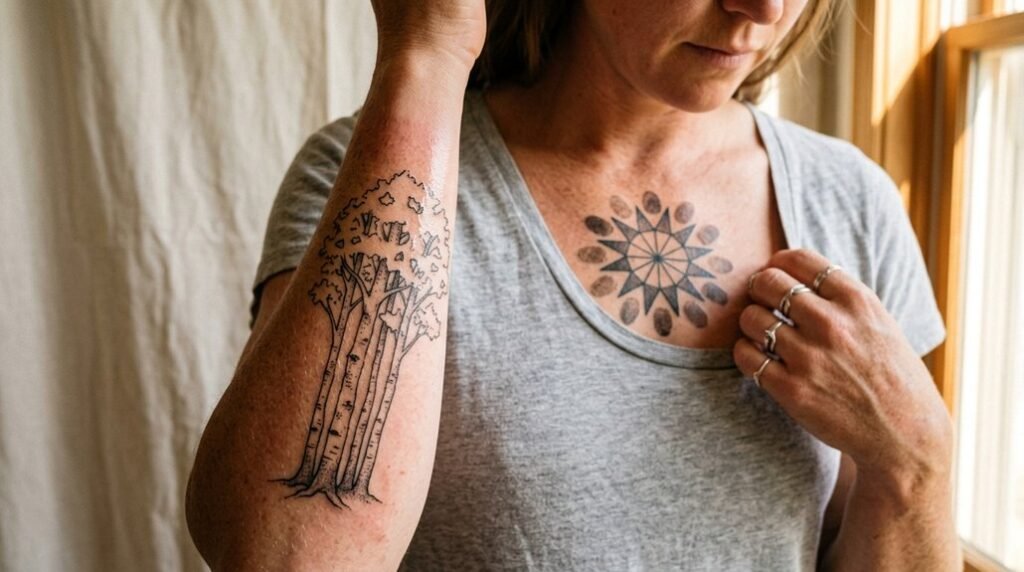
You’ve probably noticed how family tattoos show up everywhere lately—on wrists, shoulders, even fingers. Maybe you’ve considered one yourself but aren’t sure where to start. The symbols people choose aren’t random; they carry weight you might not expect. Before you settle on a design, there’s something you should know about how the wrong choice can turn permanent ink into permanent regret.
Key Takeaways
- Anchors, trees, and infinity loops represent stability, lineage, and unbroken family bonds.
- Names in script and birthdates in roman numerals create deeply personal, meaningful connections.
- Celtic knots, Claddagh rings, and Polynesian patterns honor cultural heritage and ancestry.
- Matching split designs and puzzle pieces let siblings share symbolic, decodeable memories.
- Daily SPF and moisturizing preserve ink clarity to honor the tattoo’s emotional significance.
Recommended Products

Reusable Material: Tree of Life stencil is made of premium plastic, washable and reusable, flexible and durable, not easy to break, did not bend or rip after being used multiple times

⯁ 400+ Reusable Henna Stencils: Get 24 sheets of high-quality, self-adhesive hollow templates featuring over 400 unique patterns. These temporary tattoo stencils allow you to create stunning body art including mandalas, butterflies, and dragons. Perfect for practicing techniques without permanence

Tree Stencils Kit: The kit contains 25 pieces of tree painting stencils in 25 different styles and 1 piece metal open ring, each stencil size measure about 6x6inch. Plenty in quantity, rich in style, a variety of different patterns allow you to give full play to your imagination, providing you with unlimited possibilities to create a variety of DIY art projects and enjoy the fun of creation.
Most Popular Family Tattoo Symbols: A Quick Preview
Where do you begin when every symbol carries decades of meaning? You start with the anchors—trees, hearts, infinity loops, and birds. These motifs speak before you explain them.
You recognize trees immediately, though you won’t explore their design variations here. You know hearts anchor countless pieces, pumping steady meaning onto skin. You see infinity symbols everywhere, promising unbroken bonds. You watch birds flock toward shoulders and wrists, instinct pulling them home.
You’d select Celtic knots for their endless interweaving. You’d pick anchors for stability. You’d consider birth flowers, each month carrying distinct weight. You’d weigh Roman numerals against names.
You understand these symbols function as shorthand. You carry them not for strangers, but for the ones who’d recognize your meaning without asking.
Recommended Products

Innovative Skin-Sync Technology: We don't just sit on the skin; we interact with it. By reacting organically with naturally occurring proteins in your skin's outermost layer (stratum corneum), our plant-based formula magically transforms from a transparent guide into a rich, ultra-realistic navy-black. It looks exactly like a healed, permanent tattoo—without the needles or depth.
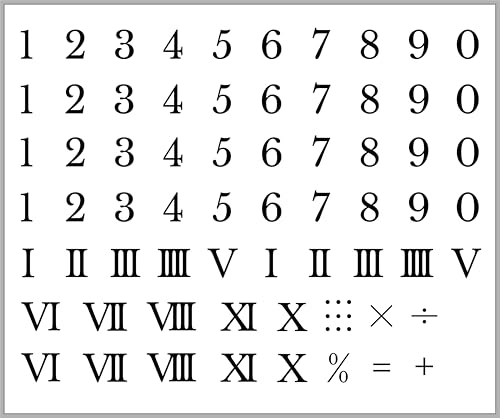
CUSTOM NUMERICAL TYPOGRAPHY: Features a comprehensive arrangement of classic Arabic numerals, a complete set of clean Roman numerals (I–X, XI, V–VIII), and essential mathematical symbols including plus, minus, multiply, divide, percent, equals, and ratio colon dots.

Package included: 30 sheets temporary letter tattoo stickers with 10 styles, each style have 3 sheets(10 letter stickers are arranged on 2 large stickers, and you will receive a total of 6 large stickers.). You can customize custom name tattoos, which have fashion style and color,make you look more unique and cool. Enough to meet your use and replacement needs.
Family Tree Tattoos: Design Styles From Simple to Sprawling
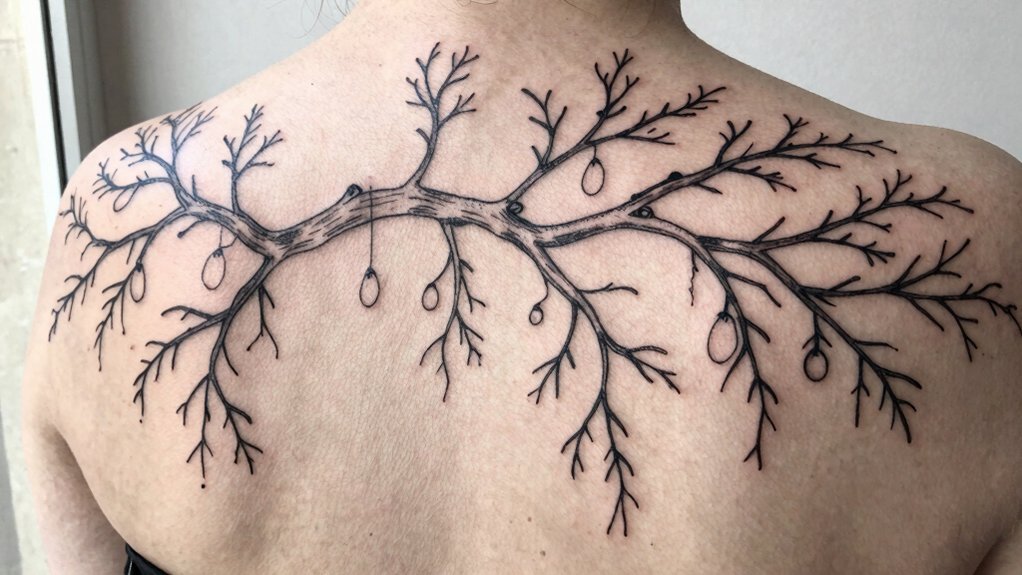
How do you map something sprawling onto skin? You choose a style that fits your story.
You might pick a simple silhouette—thin trunk, minimal branches, clean lines wrapping your wrist or ankle. This works when you want subtlety, something only you recognize as lineage made visible.
Or you stretch it across your back, your ribs, your thigh. You add roots tangled with names, each branch splitting into birth years, small leaves marking children, parents, generations gone. You use negative space, watercolor washes, or stark black ink. You decide whether birds fly from the branches or hands clasp around the trunk.
Your artist translates your family history into scale. You carry the whole network—however vast, however compact—under your clothes, a living map you update or simply preserve.
Recommended Products

Celtic Knot Animals Painting Stencil: Include 9pcs celtic knot animals stencils, 20x20cm/7.9x7.9inch, medium size, convenient for handheld operation, and able to meet the drawing needs of larger areas. Whether it's decorating cards, making handmade accounts, or creating wall art, it can be easily adapted.

PACKAGE: Get 20 sheets of 6X6 inch stencils with 20 unique Celtic patterns.

🎨What's included: you will receive 9 pieces of celtic stencils in this package, each stencil measures about 20 x 20 cm/ 7.9 x 7.9 inches, stencils with meaningful words can make you more confident
Why Parents Get Family Tattoos: Names, Birthdates, and Beyond
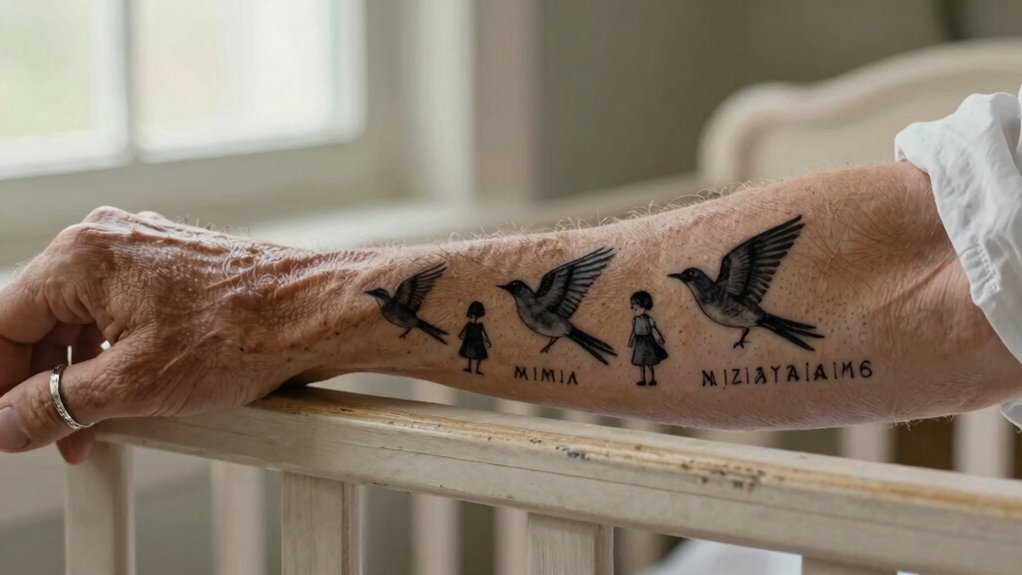
Why do you etch permanence onto your skin after someone else arrives? You mark the moment everything changed. You inscribe names in flowing script, stamp birthdates in roman numerals, trace tiny footprints exactly as they appeared. You choose placement deliberately—over your heart, along your forearm where you’ll see them constantly. You carry proof that love exists outside yourself.
You don’t stop at basic information. You incorporate elements that capture essence: a constellation mapped to their birth night, a song lyric hummed during sleepless newborn hours, an animal they’ve clutched since toddlerhood. You transform biological data into art.
These tattoos serve as anchors. When distance separates you, when time moves too fast, you touch inked skin and remember. You chose permanence because they did—arriving, staying, becoming your center.
Recommended Products

◆ What You Get: A sturdy color box include 1000 pieces puzzle and a HD print poster. Finished size: 19.7 *27.5in / 70*50 cm.Challenging puzzles!

Officially Licensed

Matching Sibling Tattoos That Go Beyond the Infinity Sign
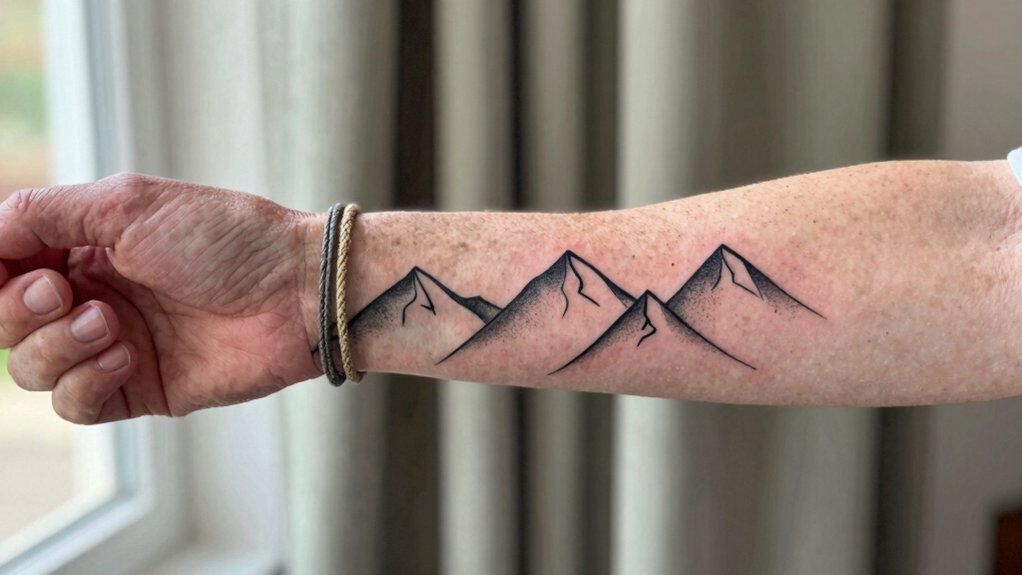
What separates your bond from every other? You’ve outgrown playing dress-up, but you’re still matching—this time under the needle.
Skip the infinity loops everyone’s got. You’ve shared a childhood nobody else understands, so your ink should reflect that private language. Split a design between two bodies: puzzle pieces that only align when you stand together, coordinates of your shared treehouse, or halves of a handwritten note you passed in third grade.
Maybe you’ll each get the other’s laugh lines sketched from a photo. Perhaps you’ll tattoo inside jokes that still make you snort at funerals. You’ve fought, stolen clothes, known every version of each other. Choose imagery only you two decode. When you’re eighty, you’ll still grin at your forearm and remember who holds the other half.
Recommended Products

142+ Nature-Inspired Tattoos Stencil Designs in 12 Sheets: This temporay tattoo template set features over 142 unique, delicate designs centered on enchanting botanical and natural elements. Discover a vast collection of flowers (daisies, roses, sunflowers, lavender), intricate leaves, winding stems, complete bouquets, elegant wreaths, crowns, bees, and butterflies. Perfect for creating floral temporary tattoos, henna-inspired patterns, and nature-themed body art.

【 761+ Fun Assorted Tattoo Stencils 】-The ChurlChurl tattoo stencils collection includes 761 high quality stencils with multiple themes. enjoy cute trendy tattoo stencil designs like butterflies, words, flowers, symbols, totem, Egypt style patterns and more.

FLOWER STENCILS: Complete 12-month birth flower stencil collection, perfect for decorating cookies, cakes, and crafts with beautiful floral designs
Cultural Tattoo Symbols for Family: Celtic, Japanese, and More
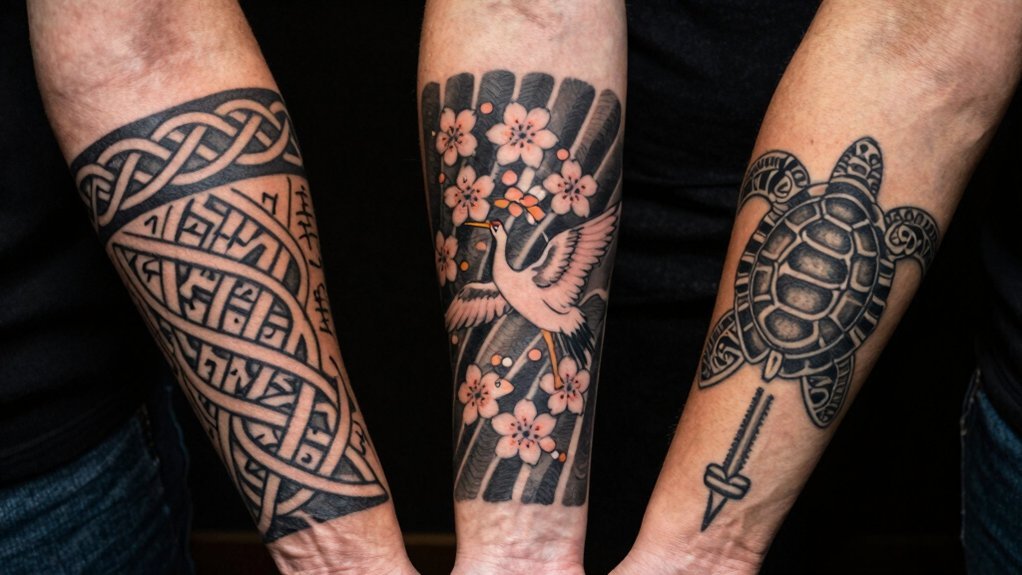
Wherever your roots reach, ancient symbols carry the weight of generations inked into skin. You’ll find Celtic knots weaving endless loops that represent eternal family bonds with no discernible beginning or end.
The Claddagh intertwines hands, heart, and crown to honor love, loyalty, and friendship among kin. Japanese artists etched *kamon* family crests for centuries, and you can adapt these heraldic designs into striking contemporary pieces. Polynesian *tatau* patterns map genealogy across shoulders and chests, each line narrating your ancestral lineage.
Nordic runes like *Othala* signify inherited heritage and homestead. You might choose the Chinese character *jia* or incorporate Adinkra symbols from Ghana, such as the *nyame dua* tree connecting earth to sky. Select imagery that resonates with your specific heritage rather than borrowing superficially from cultures you don’t belong to.
Recommended Products

Product details: the package contains 8 pieces pine tree stencils, enough for you to apply, each stencil measures approx. 6 x 6 inches, ideal for scrapbooking drawing tracing, house embellishment, making a pretty addition to your home or a nice decoration

Package Comes with: you will receive 1 piece reusable painting stencil, which is A4 size 8.3 x 11.7 inches / 21 x 29.7 cm

Easy Application: Made of durable 3-layer PVC material, these henna tattoo stencils are flexible, waterproof and easy to apply. The self-adhesive design helps keep patterns in place for clean and precise temporary tattoo designs. Does not includ ink
5 Questions to Help You Pick the Right Family Tattoo?
You’ve explored symbols from across the globe, but narrowing those options to the one design you’ll wear forever requires more than cultural appreciation. You must ask yourself five critical questions before committing.
First, what specific family bond does this represent? Parents, siblings, or chosen family each demand different imagery. Second, does this symbol carry personal meaning, or does it merely look appealing? Third, how will this tattoo age as your family evolves through births, losses, or estrangements? Fourth, where on your body will you place it, and does that location match the design’s intimacy or visibility? Fifth, can you articulate why this design—not a similar one—belongs to you?
Your answers reveal whether you’ve found a genuine emblem or just an attractive picture. Trust the process; your skin deserves authentic reflection.
Recommended Products

Fully Personalized Design - Our personalized temporary tattoos allow you to create a one-of-a-kind look with any name, quote, or phrase. These custom tattoos temporary designs are made to reflect your individual style.

Working With Your Artist on a Custom Family Tattoo Design
Once you’ve settled on a symbol that truly resonates, you’ll need an artist who can transform your vision into ink. You’ll research portfolios thoroughly, seeking someone skilled in your preferred style—whether fine-line, realism, or illustrative work. You’ll schedule consultations with two or three artists, bringing reference images, sketches, or family heirlooms that inspire you.
You’ll communicate openly about what family means to you. You’ll share stories, explain symbolism, and trust their creative expertise. They’ll sketch concepts, and you’ll provide honest feedback. You’ll collaborate until the design feels right—adjusting scale, refining details, ensuring the composition flows with your body’s contours.
You’ll ask about their sterilization practices and ink quality. You’ll book the session only when you’re completely confident. You won’t rush this partnership; great custom work demands patience and mutual respect.
Recommended Products

Metal Journal stencil - Small border celtic knot, scandinavian, viking knotwork symbol, pentagram symbols, protection sigil magick, magic, witchery. Products and supplies for papercrafting, card making and mixed-media projects

Warm Tips: The tattoo transfer paper need to work with transfer medias.You will need to purchase the stencil ointment separately. Apply the design made on the master paper. Please pay attention to press the back side of the pattern to the skin for at least 3 seconds

【Celtic Knotwork Border Stencil】You will get 1 pieces PET painting stencil of floral pattern. There are 5 lines different knotwork lace patterns, you can use them for different rooms as wall decoration, show off your personalised taste.
Where to Put It: Visibility, Pain, and Body Zones
How exactly do you want this tribute to live on your body—boldly displayed or privately held close? You decide this first. Visible spots like your forearm or collarbone announce your family bond to the world. Hidden placements—ribcage, upper thigh, behind the ear—let you carry meaning privately, revealing it only when you choose.
Consider pain tolerance honestly. Fleshier areas like your bicep or calf hurt less. Bony zones—ankle, sternum, spine—sting sharply. You’ve endured harder things for family, but don’t romanticize unnecessary suffering.
Match body zones to your design’s complexity. You need flat, stable skin for fine details and straight lines. Curved or frequently moving areas distort images over time. Think about your daily life too. Will workplace codes force you to cover visible ink? Will aging or weight changes alter your chosen spot?
You balance personal comfort, design needs, and practical constraints. Choose wisely.
Aftercare That Protects Your Family Tattoo (and Its Meaning)
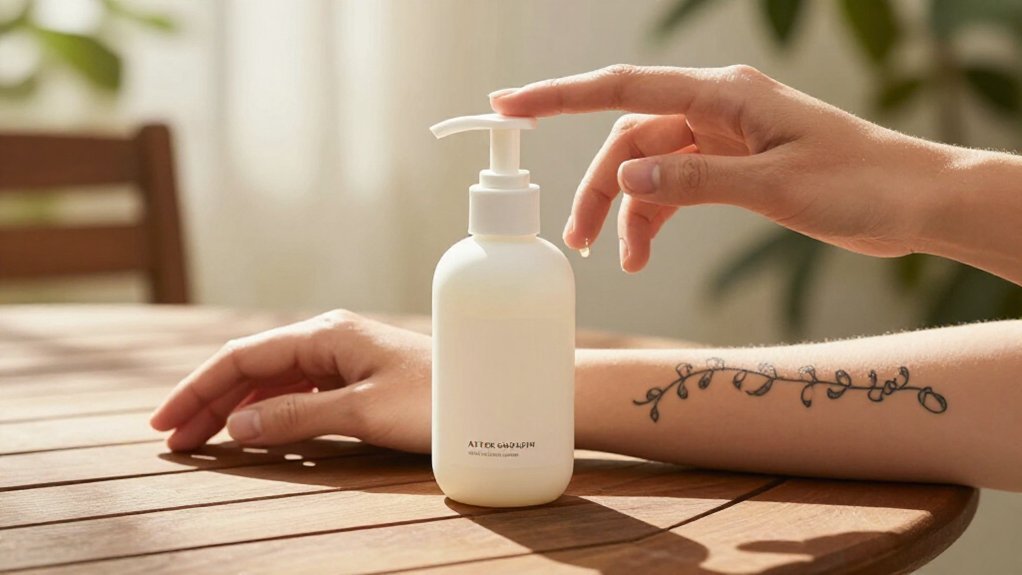
Why risk letting your permanent tribute fade into a blur of neglected skin? You protect your family tattoo by following your artist’s aftercare instructions without cutting corners. You wash it gently with fragrance-free soap, pat it dry, and apply a thin layer of recommended ointment. You resist scratching scabs, picking flakes, or soaking the fresh ink in pools, tubs, or ocean waves. You keep it out of direct sunlight and wear loose clothing that won’t stick or rub. Once healed, you slather SPF over that ink every single day because UV rays bleach pigment and blur fine lines. You moisturize regularly to keep skin supple. You didn’t endure needle pain and emotional weight for a faded smudge. You preserve the image, and you honor what it carries.
Recommended Products

【Double-headed Design】- You will get a 6pcs - liquid eyeliner set in the package, each of which is about 12.3 cm in length and 1.17 cm in diameter, with a double-headed design, one head with an delicate soft black eyeliner pencil for drawing precise eye lines, and the other head with a tattoo eyeliner stamp use for eye decoration.
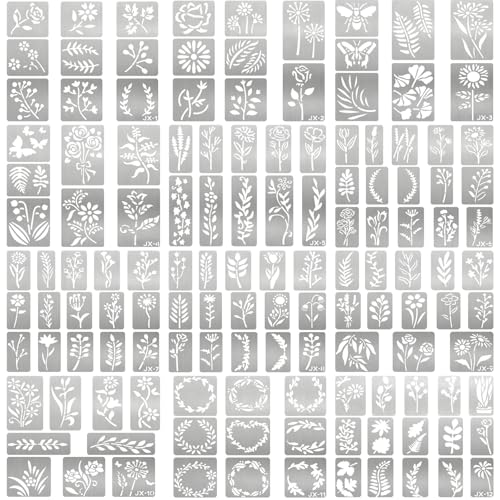
Plant Theme Tattoos Stencils: Includes 132 fake tattoo stencil featuring minimalist leaves, elegant flowers, chic ferns, and other plant designs — perfect for creating nature-inspired body art. Great for parties, photoshoots, or everyday wear. Also makes a thoughtful gift for plant lovers and DIY crafters.

【 575+ Fun Assorted Tattoo Stencils 】-The ChurlChurl tattoo stencils collection includes 575 high quality stencils with multiple themes. enjoy cute trendy tattoo stencil designs like butterflies, words, flowers, symbols, totem, Egypt style patterns and more.
Conclusion
Your family tattoo captures bonds you’ll carry forever, so choose symbols that resonate deeply with *your* story. Work closely with an artist who gets your vision, pick placement that balances meaning with daily life, and commit to proper aftercare. Whether you select a tree, names, or cultural motifs, you’re etching love into something permanent—make it count, make it yours, and let it evolve with you.