
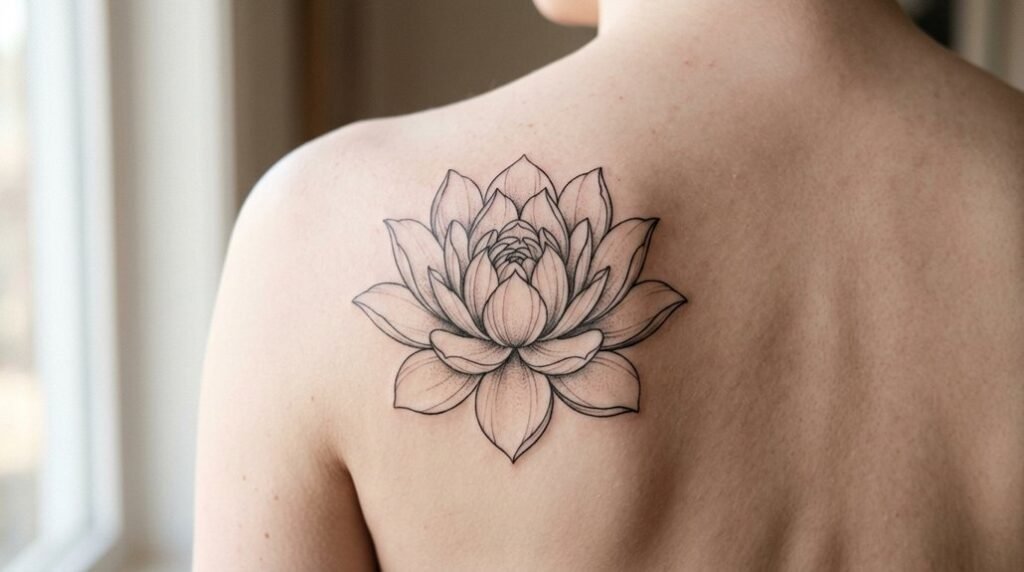
You’ve probably seen lotus tattoos everywhere, but you might not know what you’re really looking at. That simple flower carries thousands of years of meaning about struggle, change, and what comes after both. Before you settle on any design, you’re going to want to understand why this symbol has outlasted so many others—and how it might already mirror something in your own life.
Key Takeaways
- A lotus tattoo symbolizes transformation and resilience, representing the ability to rise from difficult circumstances and bloom.
- The lotus emerges unstained from murky water, serving as proof that origins do not dictate one’s outcome or potential.
- In Hinduism, it represents divine power and cosmic order, while in Buddhism, it signifies purification of the mind and enlightenment.
- Color variations carry distinct meanings: black for mystery, red for passion, white for purity, blue for wisdom, and purple for mysticism.
- Placement and style choices—such as mandala, watercolor, or geometric—allow personal customization of the tattoo’s spiritual significance.
Recommended Products

⯁ 400+ Reusable Henna Stencils: Get 24 sheets of high-quality, self-adhesive hollow templates featuring over 400 unique patterns. These temporary tattoo stencils allow you to create stunning body art including mandalas, butterflies, and dragons. Perfect for practicing techniques without permanence

【All-in-One Starter Kit】 Features 80 stencils, including 3 Pairs of Hand Designs + 1 Pair of Large Arm Stencils for bold art. Includes 4 cones (2 Black, 1 Brown, 1 Dark Red), White Sketch Pen & Full Prep Kit. All in 1 box—perfect for beginners & activities with kids!

✨ Complete Value Set: Each kit contains 6 large A4 sheets with up to 100 distinctive patterns (depending on the theme). From delicate flowers to fierce animal totems, this bulk collection offers endless creativity for DIY body art lovers, ensuring you always have the perfect design for any mood.
What a Lotus Tattoo Actually Means
Why do so many people choose a lotus design for their ink? You’re drawn to beauty with weight behind it. When you pick a lotus, you’re selecting one of humanity’s oldest symbols of transformation. You recognize how this flower pushes through murky water to bloom unstained. You’re embodying resilience, the journey from struggle to clarity. Your tattoo speaks of rising above circumstances that could’ve dragged you down. You carry proof that origins don’t dictate outcomes. You value growth you can’t rush—the lotus doesn’t force its petals open. You mark a personal evolution, a chapter closed, or strength you didn’t know you owned. You’re connecting to countless others across time who’ve looked at this same bloom and felt understood. Your skin holds meaning you’ll never outgrow.
Recommended Products

Unique Design Mandala Tattoos: Yazhiji Mandala tattoos are a beautiful blend of artistry, spirituality, and self-expression. They offer a way to wear a design that is not only visually stunning but also rich in meaning and symbolism. Whether you’re drawn to the traditional aspects of mandalas or prefer a modern interpretation, our mandala tattoo can be a deeply personal and reflective choice alowing you to embrace the harmony and beauty of these captivating symbols.

Henna Tattoos Flower Temporary Tattoos: The package comes with 10 sheets black henna Temporary Tattoos. Each pattern has a unique design, attractive and creative. The size of each sheet is approximately 4.7 * 2.7 inches

✔[LOTUS TEMPORARY TATTOO] Briyhose Lotus Flower Temporary Tattoos Can Cover Your Body Parts Large. It Contains 8 Sheets 7.48 * 4.72 Inch (19 * 12cm) Floral Lotus Indian Tribal Fake Tattoo Stickers For Adults Men Women Tatto Kit. You Can Share It With Your Family And Friends.
Lotus Symbolism in Buddhism vs. Hinduism
The lotus carries distinct spiritual weight across Eastern traditions, and you’ll find its meaning shifts subtly between Buddhist and Hindu contexts.
In Hinduism, you’ll encounter the lotus as a seat of divine power. Gods and goddesses sit upon open blossoms, and you’ll see Vishnu holding one in his hand. The unfolding petals represent spiritual awakening, but you’ll notice the emphasis falls on cosmic order and beauty emerging from the universe itself.
Buddhism offers you something different. You’re looking at purification of the mind here. The Buddha and bodhisattvas stand or sit on lotus thrones, yet you’ll discover the symbolism centers on individual liberation. Your consciousness rises through suffering toward enlightenment, with each petal marking a stage of spiritual development.
Your tattoo choice matters: Hindu lotuses honor divine presence; Buddhist ones trace your path through self-discipline.
Recommended Products

Innovative Skin-Sync Technology: We don't just sit on the skin; we interact with it. By reacting organically with naturally occurring proteins in your skin's outermost layer (stratum corneum), our plant-based formula magically transforms from a transparent guide into a rich, ultra-realistic navy-black. It looks exactly like a healed, permanent tattoo—without the needles or depth.

【Spiritual Lotus design】This design blends lotus flowers with OM symbols to express harmony, mindfulness, and inner strength. The fine-line approach keeps the artwork calm and refined, making it ideal for hands and arms. A quiet spiritual style with timeless symbolism.

FLOWER TEMPORARY TATTOOS--the fake temporary tattoos has 10sheets different rose flower lily patterns. you can used these tattoos for arms, face,shoulders, back,chest,legs,neck and worn any where on your body show your personality
From Mud to Bloom: Why the Growth Cycle Matters
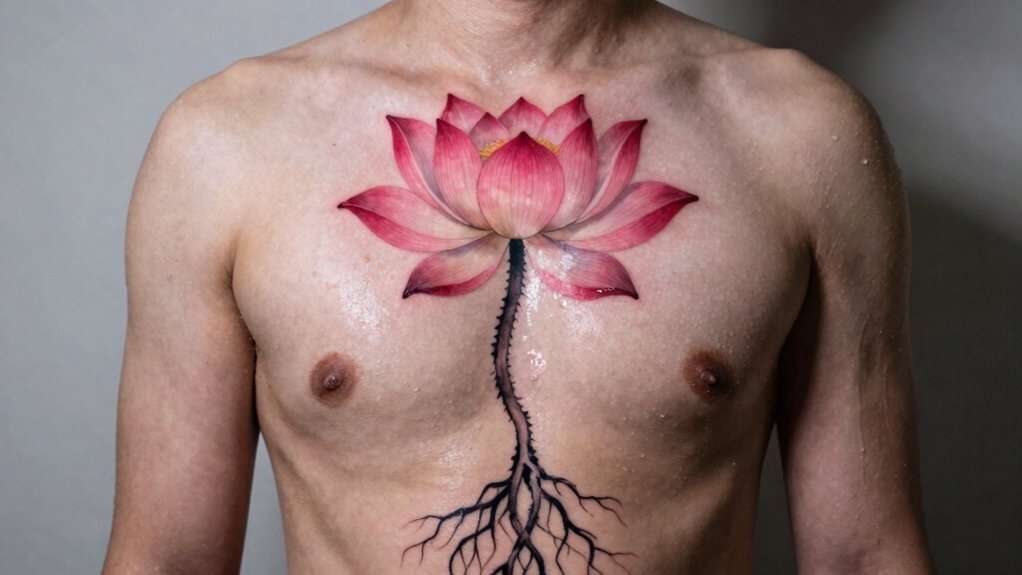
Beyond these religious frameworks, you’re looking at something more universal in the lotus: its stubborn refusal to stay dirty. You’re witnessing a flower that pushes through murky water, fighting upward until it breaks the surface and opens clean. That journey captivates you.
When you choose this tattoo, you’re mapping your own struggle onto that arc. You’ve probably clawed through something—grief, addiction, failure—and emerged. The lotus doesn’t skip the mud; it needs it. You’re embracing that paradox.
Your skin carries the proof that transformation demands darkness. You’re not inking a destination. You’re honoring the passage itself: the sinking, the effort, the bloom. It’s your private declaration that you’ve earned your present self, one inch at a time.
Recommended Products

Lotus Flower and Om Symbol Design: This wall sculpture features a beautifully crafted lotus flower and the sacred Om symbol, creating a serene and spiritual ambiance in any space.

Super Large Size: 4 pieces included, each measuring 14.1 x 49 inches, with a total combined size of 56.4 x 49 inches (143 x 124 cm)

Koi Fish Wall Art Excellence: Beautifully capture the serene symbolism of koi fish and lotus in this vintage-inspired canvas art, perfect as koi fish wall art or Asian-themed home decoration.
What Lotus Tattoo Colors Reveal About You
How do you want the world to read you at a glance?
When you pick black, you’re claiming mystery and rebirth through darkness. You embrace complexity without apology. Red ink screams passion, power, fierce love—you’re not hiding your fire. You wear white and announce spiritual awakening, purity of intent, a mind rising above.
Pink softens you: devotion, gentle enlightenment, the Buddha’s earthly connection. Blue demands they see wisdom, knowledge, the victory of spirit over senses. You’ve mastered something. Purple proclaims mysticism, esoteric depth, the eighth Buddhist path. You walk edges others fear.
Yellow or gold? You radiate openness, full enlightenment, complete ascension. You’ve arrived somewhere.
Your chosen hue doesn’t decorate skin—it broadcasts your inner architecture. You select your truth before speaking a single word.
Recommended Products

ANCIENT GRAIN - With rich historical significance to the regions of China, Black whole grain rice was referred to as "longevity rice" for its rich health benefits


Where on Your Body to Place a Lotus Design
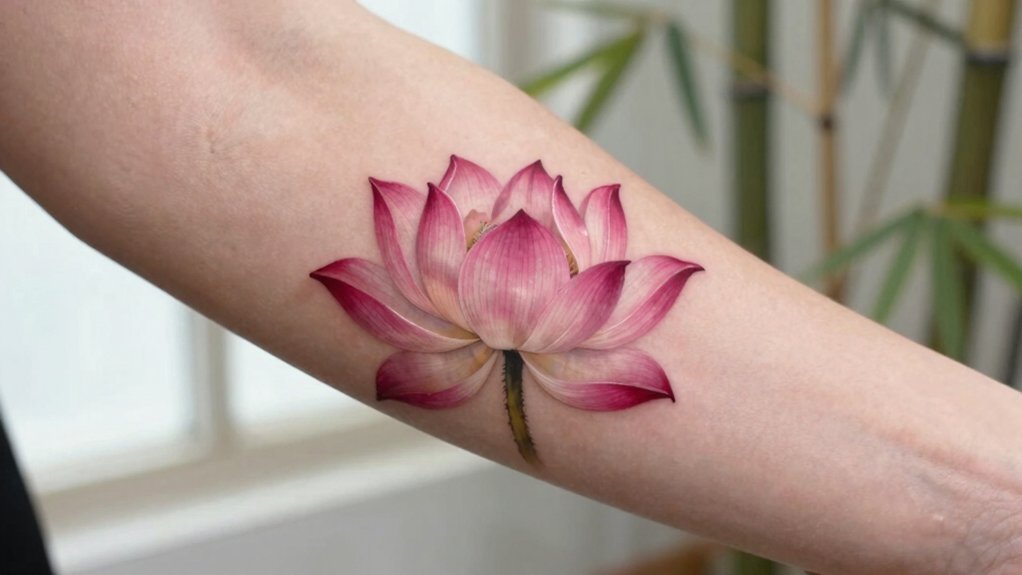
You’ve chosen your color. Now you’ll decide where your lotus lives on your skin.
Your wrist offers daily visibility—you’ll catch glimpses of resilience during mundane tasks.
Your shoulder blade provides a canvas for larger, flowing designs; you’ll reveal it selectively.
Your ankle suggests groundedness, roots absorbing strength from below.
Your spine invites vertical growth, each vertebra echoing the stem’s upward journey.
Consider your pain tolerance. Ribs and feet challenge you; outer arms comfort you.
Think about your professional life. Some placements hide easily; others announce themselves.
Your lotus should bloom where you’ll appreciate it most. Morning coffee or evening mirror—you’ll encounter your symbol when you need reminding.
Trust your instinct. You’ll carry this mark; choose a home that feels like yours.
Recommended Products

🎃[4 Sheets Groovy Long Lasting India Tribal Black Tattoos Temporary] There Are 4 Sheets Mandala Flower Temporary Tattoos For Women Girls Teens, You Can See Geometry Round Lace Flower Floral Wedding Bridals Bride Lotus Fake Jewelrys Stencils Template Designs In It.

1 Set = 12 Sheets Henna Tattoo Stencils, 6 Pairs Right and Left hands stencils. Pasting position: Hand, Finger,Forearm, etc. Suitable for Henna tattoo, Airbrush Painting, Glitter tattoo, and so on;
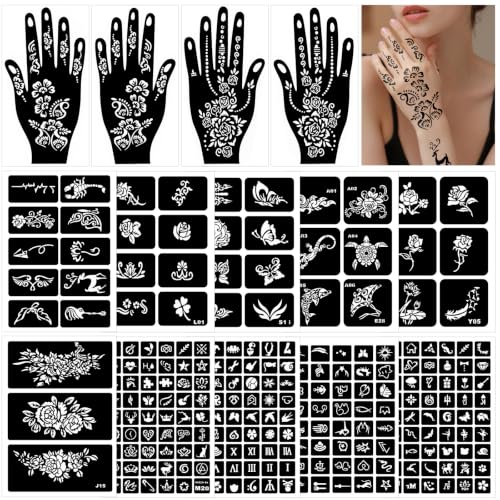
Set Combinations: Ncludes 4 hand tatouage (width 4.33 and length 8.22 inches), 243 pieces of tattoo stencils in 6 sizes there are small tattoo designs, medium tattoo designs and large tattoo designs. Meet your different possibilities! Temporary tattoo kit stencils for tattoo beginners.
Mandala, Watercolor, or Geometric: Picking Your Style
Which style will carry your story? You choose between three distinct paths. Mandala lotus tattoos wrap your skin in intricate, circular patterns that echo spiritual wholeness. You’ll find symmetry and meditation in every line.
Watercolor styles let color bleed and bloom across your body like ink dropped into water. You embrace imperfection and artistic freedom with this choice.
Geometric lotus designs strip the flower to clean angles and bold shapes. You favor modern precision over organic curves.
Consider your personality. You might layer mandala details with watercolor washes. You could anchor geometric petals with soft color gradients. Your artist translates your vision into skin. Trust your instinct. The style you pick becomes your permanent statement.
Recommended Products


🐙4 Sheets Unique Groovy India Black Temporary Tattoos Sticker:🐠 There Are 4 Sheets Tribal Temporary Tattoos For Women Adults 21x15cm 8.2"x5.9" Including Various Popular Designs Round Lace Hands Boho Bohemia Geometry Lotus Mandala Flower Florals Tatoos Stencils Template.

💕【64 Sheets Black Temporary Tattoos For Women Girls】--VANTATY 3D Realistic Temporary Tattoos For Adults Women Kids Adults Girls Body Art Stickers Look Real! 【Click Our Store/Brand Name To See More Fashion Designs】Tribal Lion Wolf Indian Feather Lotus Butterfly Bohemia Boho Lotus Mandala Flower Floral Animals Elephant Tattoos Dreamcatcher Serpent Dream Catcher Owl Moon Turtle Hummingbird Skull Skeleton Snake Bat Bowknot Dolphin Moon Crown.
How to Make Your Lotus Tattoo Uniquely Yours
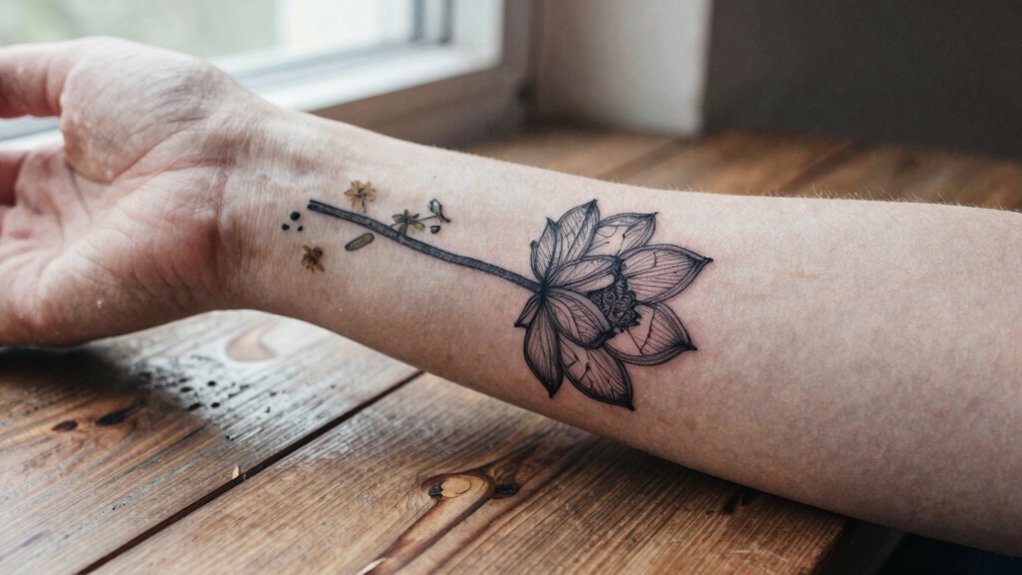
Why settle for a design anyone could wear when your lotus tattoo can carry marks only you understand? You weave personal symbolism into every petal. You add your birth flower alongside the bloom, or tuck your child’s initials into the stem. You choose a specific number of petals to mark a meaningful date.
You’ve survived something? You position the lotus half-submerged, roots deep in dark water, breaking into light. You honor heritage with patterns from your grandmother’s textiles. You merge the bloom with a phoenix, a crescent moon, a hummingbird—whatever mirrors your journey.
You select placements that shift with your movement: unfolding across your shoulder blade, closing at your ribcage. You work with artists who sketch until the lines feel like yours. Your lotus becomes a fingerprint, impossible to duplicate.
Recommended Products

Semi Permanent Tattoo Stickers: High-quality temporary tattoos that last 7-14 days, gradually fading as your skin naturally exfoliates. Made with skin-safe, plant-based inks that meet international safety standards.

【UNIQUE AMAZING DESIGNS】Each Size is about 10.5 x 6 cm / 4.1 x 2.36 inch. Contains 6 sheets temporary tattoo paper stickers which are printed with non-toxic ink.

【Style and Elements】 30 sheets of Yoga style temporary tattoos in different size including lotus, OM, Sanskrit, Tibetan, lycoris, mandala, flower, elephant, moon, peacock feather, meditation, fearless, golden sun and more.
What to Know Before Booking Your Appointment
Once your design feels unmistakably yours, the real work begins—finding who’ll transfer it to skin.
Research artists thoroughly. Study their portfolios for clean lines, consistent shading, and healed results. Don’t settle for proximity over quality.
Book consultations with your top choices. Ask about their experience with floral work and color saturation. Discuss placement, sizing, and how your lotus will age. Bring reference images, but trust their professional adjustments.
Verify their licensing and studio hygiene. Watch them open new needles. You’re paying for safety as much as artistry.
Prepare properly: hydrate, eat beforehand, and avoid alcohol. Wear comfortable clothing that exposes the area easily.
Understand that good work costs more. Budget for the artist’s rate, tip, and future touch-ups. This permanent decision deserves patience, not haste.
Recommended Products

Buddha Wall Art: Immerse your space in the serene presence of our exquisite Buddha wall art, bringing peace and tranquility to your home or office.

【Lotus Flower Wooden Wall Art】These lotus wall artworks are made by hollowing out,with an overall color of brown,simple and elegant.They can bring a peaceful and warm atmosphere to your place and make your mind more relaxed

Multiple Sizes & Versatile Use: Available in sizes ranging from 8x10 inches to 24x36 inches, this wall art is suitable for bathrooms, bedrooms, living rooms, offices, farmhouses, kitchens, and more. It can be displayed on walls, over sofas, or as part of a gallery wall.
Conclusion
Your lotus tattoo becomes whatever you’re growing through. You’ve seen how color, placement, and style shift the meaning—and how Buddhist clarity differs from Hindu divine power. Now you’re ready to book with intention. Choose an artist who’ll translate your specific journey into ink. The mud you’ve risen through deserves more than a generic bloom; it deserves your story, permanently marked.
Recommended Products

Spiritual Meditation Art design. Radiate good vibes and express your inner yogi with this zen lotus design to evoke the essence of shanti peace, meditation, mindfulness, cosmic consciousness, and universal love as a reminder to express your true self.

【Package Content】: There are 4 pieces of diamond encrusted car coasters. The round diameter is 2.75 inches and the thickness is 0.23 inches. The crystal clear crystal rhinestone match complement each other, will make your car interior look more luxurious and add personal charm.

【High Quality & Comfort】: It is made of elastic and leather, which is not easily worn and scratched. The elastic fabric is stretchy and not easily deformed. The leather is waterproof and easy to clean. It is soft and breathable, with a smooth surface and a delicate skin-friendly feel, giving you a comfortable driving experience.