
You’ve probably seen rose tattoos everywhere, but you might not realize how much they’re actually saying. A red bloom on your chest whispers something entirely different than a black one curled behind your ear. Before you commit ink to skin, you’ll want to know exactly what story you’re telling—and what hidden layers others might see.
Key Takeaways
- Rose color determines core symbolism, with red representing passion, white signifying purity, black indicating mystery, and yellow denoting friendship.
- Cultural traditions infuse roses with specific meanings, from Japanese irezumi balance to Celtic eternal love and Mexican ancestral devotion.
- Tattoo style shapes narrative interpretation, as realistic designs suggest fragility, traditional styles evoke rebellion, and geometric patterns imply order.
- Body placement alters significance, with neck tattoos signaling defiance, chest pieces holding intimate meaning, and hands representing daily action.
- Combined imagery like daggers, skulls, or clocks creates complex personal narratives about mortality, danger, or the passage of time.
Recommended Products

【 7 sheets 】 -7 temporary tattoo stickers, including 3 large red roses, size 7.5x3.6 inches (19cmx9.3cm) and 4 sheets 8.3x4.6 inches (21cmx11.5cm)

Great gift: Birthday party gifts for women, children, daughters and sons.

【 32 sheets 】 32-temporary tattoo stickers, including:1pc:large black roses size(21cmx15cm) ,8pc:6red roses+2artistic Writing size(19cmx9.3cm) 3pc:2pc Pink Rose 1pc Pink Butterfly,size(10cmx6cm),20pc:Black roses and flowers size(7cmx5cm)
Red Rose Tattoo Meaning vs. Black, White, and Yellow: A Complete Guide
Why settle for a generic rose when color transforms your tattoo’s entire message? You choose red when you want passion, romance, and deep love etched into your skin—it’s the classic declaration that never fades.
You select black when mystery calls you; you’re honoring loss, marking rebellion, or embracing life’s shadows with stark elegance.
You pick white when purity, new beginnings, or remembrance guides your hand—it’s soft but carries weight.
You go yellow when joy dominates; you’re celebrating friendship, optimism, or a spirit that refuses to dim.
Each shade speaks its own language on your body. You’re not just selecting a hue—you’re defining what you carry forward. Your choice becomes your silent signature, visible and permanent.
Recommended Products

⚡High Quality Long-Lasting Flower Tattoos -- look spectacular 24/7 for longer as our tattoos will last for several days. These sexy fake tattoo can show your personality and express your ideas.Guaranteed to dazzle, our black tattoos stickers are perfect for women girls to get noticed wherever you are.

VINTAGE BLACK ROSE ART: Features a bold duo of traditional old-school black roses, showcasing layered blooming petals flanked by sharp, dark-veined leaves. This gothic floral set is crafted using a digital hand-drawn fine line tattoo ensures crisp lines and flawless gradient shading to deliver distinct woodcut-style whip shading, heavy stippled textures, and classic American traditional bold black ink outlines.

Rose Temporary Tattoos : You'll receive 8 sheets rose flower temporary tattoos, each measuring 12x17cm (4.7x6.7 inches). No designs repeat, so you can switch them up and share them anytime
What Do Rose Tattoo Meanings Look Like Across Japanese, Mexican, and Celtic Traditions?
Where do roses carry the weight of entire civilizations? You find your answer in Japanese irezumi, where roses mingle with koi and dragons, symbolizing balance between beauty and life’s fleeting nature. You embrace*this* *as* *a* *testament* *to* *resilience* *amid* *impermanence*.
In Mexican traditions, you encounter roses woven into Day of the Dead imagery and Virgin of Guadalupe iconography, representing devotion, remembrance, and the sacred bond between life and death. You feel the spiritual intensity pulsing through each petal.
Celtic designs reveal roses encircled by knots and thorns, tying you to unbreakable love and eternal loyalty. You recognize how these cultures transform the rose into something far deeper than mere decoration—you’re witnessing living history etched into skin, carrying ancestral wisdom through every line.
Recommended Products

🌼 Beautiful Hand-drawn Fine Line Style Tattoos - Black and White Fine Line Flowers, Roses, Branch, Butterfly, Arrows, Hearts, Stars

LARGE: Sheet size 6"X 6"

Paper size 17cm, height 24cm, 8 sheets of 21 tattoo patterns,This is a large size temporary tattoo with a rose flower design as the theme, the rose flower symbolizes love and sincere and pure love, peace, friendship, bravery and dedication, our designer carefully hand-painted the design of the rose flower tattoo
Why Your Rose Tattoo Style Changes the Meaning: Realistic, Traditional, and Geometric
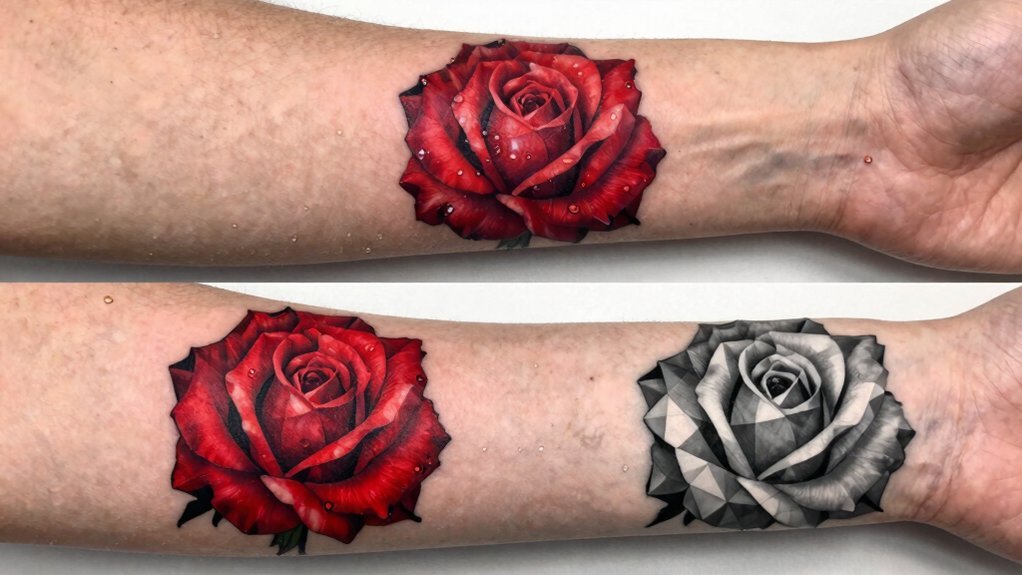
How dramatically does your chosen style reshape what your rose conveys? You’d be surprised how much the artistic approach matters.
When you choose a realistic style, you’re wearing a frozen moment of natural beauty. You emphasize fragility, mortality, and romantic nostalgia. Your tattoo breathes like a photograph pressed into skin.
When you pick traditional American styling, you’re connecting to rebellion and working-class heritage. Your bold lines and saturated colors shout resilience, not delicacy.
When you select geometric designs, you’re transforming nature into mathematics. Your rose becomes structure, balance, and cosmic order. You’re showing control over chaos.
Each style tells a different story about who you are. You’re not just choosing how it looks—you’re deciding what it means.
Recommended Products

6 Sheets rose temporary tattoos; Each sheet measures 6cm* 10.5cm/2.36*4.13 inch (L*W)

👑[SUPER QUALITY & SAFE] - Temporary tattoos are in compliance with US FDA and EU CE standards, LONG LASTING, REALISTIC, WATERPROOF, NON-TOXIC and NON-ALLERGIC, also suitable for kids greater than 3 years old. 5-7 days lasting depends on applied position, times of showers and scratching frequency.

✿【Flower Tattoo Stickers】Contains 40 pcs of small flower tattoo stickers, measuring 6x5cm/2.4x2in. Available in a variety of colors and patterns, you can apply them on any part of your body, such as arms, legs, face, shoulders, back, neck, waist, feet, and can also cover scars on your body.
How Rose Tattoo Placement Affects Meaning: Neck, Hand, Chest, and Beyond
When you shift your rose tattoo from hip to neck, you’re not just changing coordinates—you’re rewriting its message.
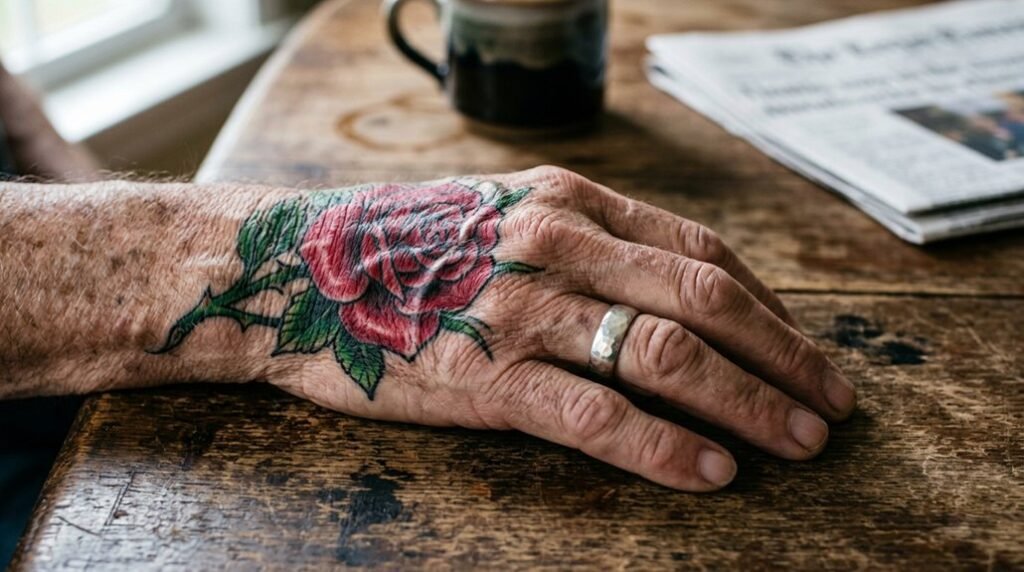
You place a rose on your neck, and you broadcast defiance. You can’t hide it; you’re claiming visibility. You ink your hand, and you transform the rose into action—every handshake carries your symbol forward. You choose your chest, and you nestle meaning against your heartbeat, guarding something intimate or memorial.
You select your forearm, and you balance display with discretion, rolling sleeves to reveal or conceal. You tattoo behind your ear, and you whisper your story, sharing only when you turn.
You’re mapping meaning onto your body. Placement isn’t logistics—it’s syntax. You’re constructing sentences with skin, and where you position each bloom determines who reads your language, and when.
Recommended Products

⚡High Quality Long-Lasting Sexy Flower Temp Tattoos for Womens -- look spectacular 24/7 for longer as our tattoos will last for several days. These sexy fake tattoo can show your personality and express your ideas.Guaranteed to dazzle, our black tattoos stickers are perfect for women girls to get noticed wherever you are.

【Develops Fully in 48H】Your unique realistic cross rose & rose quotes designs semi permanent hand tattoo will initially appear silver before naturally darkening to a rich finish within 48 hours. For optimal results, avoid contact with bare skin (particularly the face) and cover the area with clothing during sleep to prevent transfer. Realistic cross rose & rose family quotes designs for women hand wrists ankles, temporary fake tattoos for women adult

⚡Awesome Realistic Flowers Temporary Tattoos for Women -- Super stylish design temporary tattoos, set includes variety of sizes that you can use for different locations on your shoulder, arms, chest, etc. Easy to share it with your family and friends.
What Rose-and-Dagger and Rose-and-Skull Combinations Really Communicate
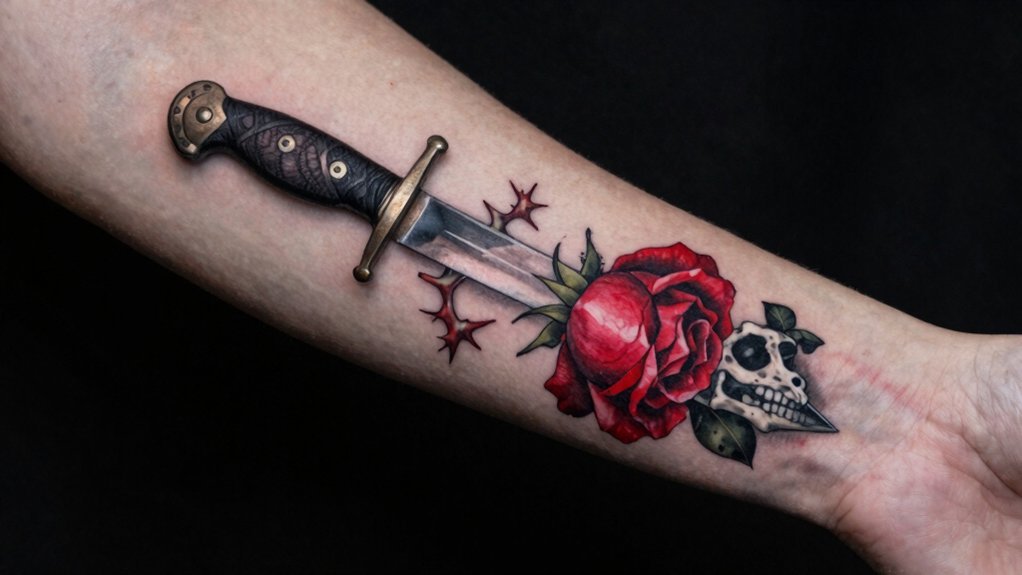
Why pair beauty with something sharp or dead? You make this choice when you want tension on your skin. The rose-and-dagger design throws balance against danger. You carry both delicacy and defense. Maybe you’ve lost love, or you guard it fiercely. The dagger pierces the bloom, and you feel time’s fragility cut through.
You pick the skull-and-rose pairing when you confront mortality directly. Death and life share one stem; you don’t flinch from that. You’ve buried someone, or you’ve nearly died yourself. The skull grins beneath petals, and you wear the irony: beauty survives anyway. You don’t choose these combos for decoration. You stamp your struggles where others can see. Your story bleeds through the contrast.
Recommended Products

4 Sheet rose flower temporary tattoos; 3 sheet measures 15x21cm/5.9x8.26inches, 1 sheet measures 12x19cm/4.7x7.5inches

RED GOTHIC ROSE FLOWER - 2 X temporary tattoos Red Roses 8.2x 5.9 inches

How to Design a Rose Tattoo Meaning That Actually Fits Your Story
You’ve seen how contrast sharpens meaning—now it’s your turn to build something personal. Start by asking what you’re honoring, surviving, or becoming. A blooming rose marks growth; a wilting one memorializes loss. Choose your stage deliberately.
Pick colors that carry your truth. Red isn’t generic passion if it echoes your mother’s garden. Black needn’t signal death—it can voice rebellion or quiet grief. Match elements carefully: a clock with a rose roots love in time; a snake coiled around thorns exposes betrayal’s sting.
Placement deepens narrative. A rose over your heart differs from one climbing your spine. Scale shifts impact too—delicate linework whispers; bold trad work shouts.
Finally, vet your artist. Find someone who translates emotion into ink, not just reproduces Pinterest boards. Your story deserves custom architecture, not a template wearing your skin.
Recommended Products
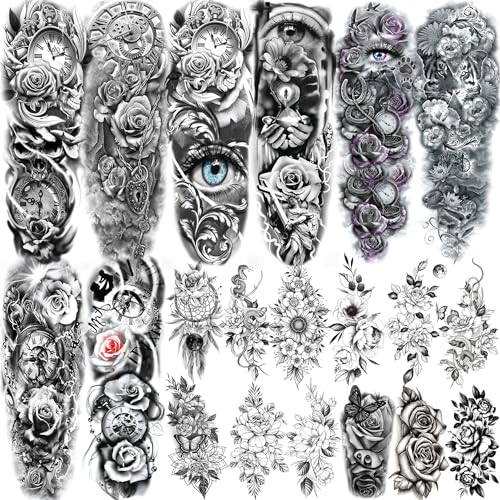
💗【20 Sheets SHELYEXIEN Brand Full Sleeve Temporary Tattoos For Women Adults】 Big Super Large Fake Sleeve Tattoos For Women Girls Including 3D Gothic Clock Tribal Indian Maori Totem Armband Virgin Mary Prayer Rose Flower Peony Florals Tiger Eye Gear Compass Clock Loyalty Faith Belief Family Love Totem Tatoos Animals Coyote Beast.

Size:60mm x 105mm (2.36" x 4.13")

【TEMPORARY TATTOO PACK FOR MAN WOMEN ADULTS KIDS】Each Size is about 11.4 x 21 cm / 4.48 x 8.26 inch. Contains 8 sheets temporary tattoo paper stickers which are printed with non-toxic ink.
Conclusion
You carry your story in every choice you make—color, style, placement, and companions. Your rose tattoo isn’t just ink; it’s a declaration of who you’ve been and who you’re becoming. Whether you bloom in defiance, remembrance, or hope, the meaning lives in your intention. Design boldly. Wear it honestly. Let your skin tell the truth only you can speak.
Recommended Products

【TEMPORARY TATTOO PACK FOR MAN WOMEN ADULTS KIDS】Each Size measuring 150 x 100 mm / 5.9 x 3.9 inch. Contains 4 sheets temporary tattoo paper stickers which are printed...