
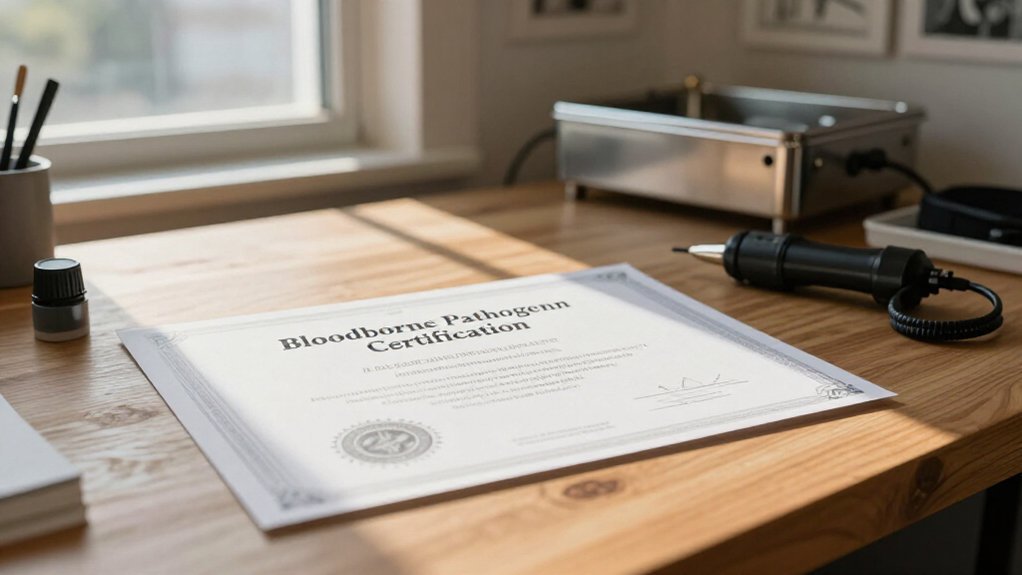
Daedalus built wings from wax and feathers, but you’re building something more permanent on human skin. Bloodborne pathogen certification isn’t optional paperwork; it’s your shield against HIV, HBV, and HCV, the viruses that turn a single needlestick into a life-altering risk. You’ll learn universal precautions, proper PPE use, and exactly how to handle that moment when blood meets broken barrier.
The training takes hours, not days, and the certificate expires yearly in most states. But here’s what most artists miss until it’s too late.
Do You Need Bloodborne Pathogens Certification?
If you’re working in a tattoo studio, you’ll need bloodborne pathogens certification when your job involves contact with blood or other potentially infectious materials. Bloodborne Pathogens Training teaches you how to protect yourself and clients from communicable diseases during procedures that break the skin.
When Certification Is Required
You’ll need Certification for Tattoo Artist status if you pierce, tattoo, or otherwise penetrate skin as part of your work. OSHA Bloodborne Pathogens standards, specifically 29 CFR 1910.1030, mandate this training for employees with reasonably anticipated exposure to blood.
OSHA mandates bloodborne pathogens training for any employee with reasonably anticipated exposure to blood during skin-penetrating procedures.
Many states require passing an exam, often with scores of 70% or higher, for initial licensure. Certification typically remains valid for one year, so you’ll need renewal to stay compliant. Additionally, you’ll usually document hepatitis B vaccination status or sign a declination form alongside your training completion.
Recommended Products

Health and safety standards Easy understanding Practice and quizzes
Who Needs Training: Tattoo Artists, Piercers, and Permanent Makeup Artists
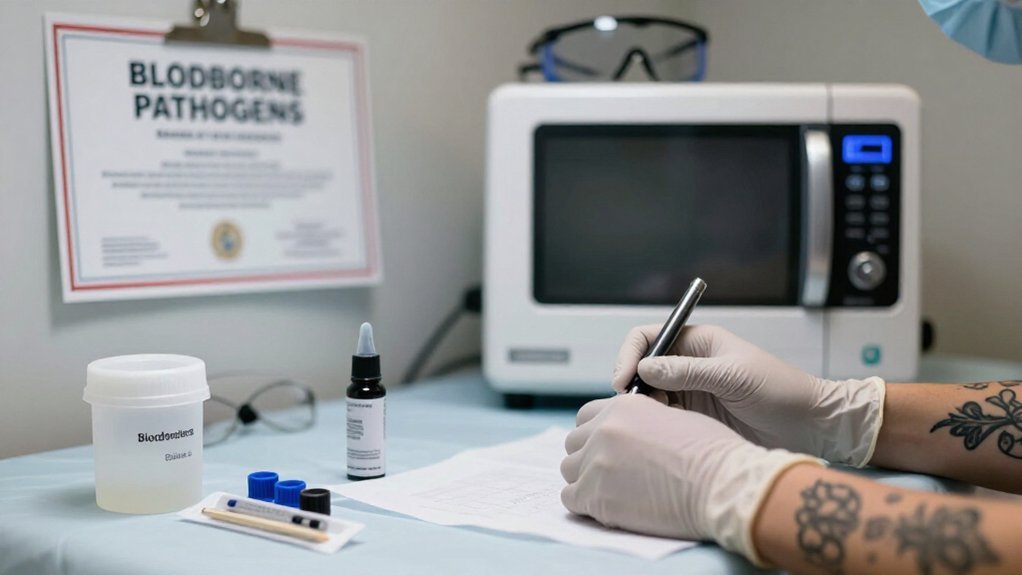
You face real occupational exposure risks every time you pierce skin, break barriers, or handle contaminated tools. Bloodborne pathogen training teaches you how to protect yourself and your clients from infections like HIV and hepatitis B.
Many states won’t let you work without proof you’ve completed an approved course, often requiring a passing exam score and specific documentation for your license or registration. You’ll need to check your local health department’s rules, since requirements for training providers, exam percentages, and renewal timelines vary substantially by jurisdiction.
Recommended Products


Bloodborne: 1-3 boxed set (graphic novel)
Occupational Exposure Risks
Since your work involves piercing skin and handling needles, you’re at direct risk for bloodborne pathogen exposure. The Bloodborne Pathogens Standard defines occupational exposure risks you face daily, requiring your studio to maintain an Exposure Control Plan and provide Personal Protective Equipment.
You encounter blood and bodily fluids with every procedure. HBV, HCV, and HIV enter through needlesticks, splashes to eyes, cuts on your hands, or contact with mucous membranes. One moment of inattention creates lifelong consequences.
Consider these realities you navigate: A single needlestick can transmit infection before you recognize symptoms. Your client’s health status offers no visual guarantee of safety. Hepatitis B survives outside the body for seven days, waiting. HIV progresses silently while damaging immune defenses permanently. Cuts on ungloved hands become direct entry routes for pathogens.
Every procedure demands vigilance.
Regulatory Compliance Requirements
Bloodborne pathogens training isn’t optional when your work breaks skin, so you’ll need certification before you touch your first client. You’re reasonably anticipated to be exposed to infectious material through needlesticks, splashes, or contact with blood during tattooing, piercing, or permanent makeup procedures. This means you must complete an OSHA mandated training program that covers Universal Precautions, PPE use, and post-exposure protocols.
Who Needs This Training
You’ll need proof of completion if you’re a:
- Tattoo artist
- Body piercer
- Permanent cosmetics or microblading artist
Keeping Your Certification Valid
Your certification stays current through periodic renewal, typically annual. Requirements vary by state and county, so confirm your course meets local standards. Some jurisdictions, like Florida, require scoring at least 70% on your exam for initial licensure.
Online Courses vs. In-Person: Which Format Fits Your Schedule
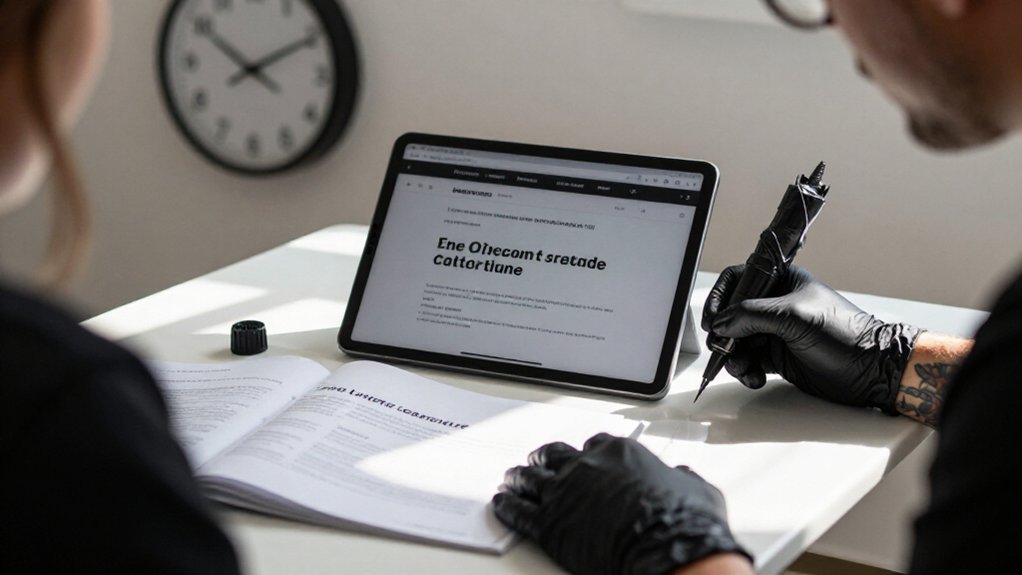
You can complete online Bloodborne Pathogens certification in about an hour, which fits easily between clients or after shop hours. You’ll get instant access to your proof of completion, including downloadable certificates with QR-code verification, so you meet licensing requirements faster than waiting for in-person processing.
Choose online if you need flexible, device-friendly training, or select in-person if you prefer live instruction with real-time Q&A.
Flexible Pacing Benefits
Whether you’re juggling back-to-back appointments or managing irregular studio hours, finding time for certification can feel like another deadline stacked on an already crowded calendar. An Online Course for Bloodborne Pathogens Certification solves this by letting you control your own timeline.
You pause when a client walks in, and resume when the chair empties.
You finish the training course in 2, 3 hours, split across lunch breaks or late nights.
You study on your phone, tablet, or laptop, wherever you land between sessions.
You revisit modules anytime during your access period, preparing for that one-year recertification without panic.
You meet compliance on your terms, not a classroom’s fixed schedule.
This flexibility keeps your focus on your craft, not on rearranging your life.
Immediate Access Advantages
When your certification deadline looms and the next available in-person class is three weeks out, you’re stuck between a compliance gap and a calendar that won’t budge. Online Bloodborne Pathogens Certification for Tattoo courses eliminate that bottleneck entirely. You enroll instantly, start immediately, and finish on your terms.
Key Access Benefits:
- Zero wait time: No instructor scheduling, no travel, no fixed classroom hours
- Immediate proof of completion: Digital certificates with QR verification arrive seconds after you pass
- OSHA-aligned training for tattoo artists: Meets compliance requirements without disrupting client appointments
Most modules run about 60 minutes, self-paced across any device. Need multiple staff certified? Account-based access speeds onboarding.
In-person training demands rigid attendance, while online options flex around unpredictable studio hours. You control the timeline, not the other way around.
What You’ll Learn: Exposure Prevention and Safe Work Practices
Because bloodborne pathogens like HBV, HCV, and HIV spread through contact with blood or other potentially infectious materials, you’ll need to understand exactly how exposure happens in a tattoo environment. During Bloodborne Pathogens Training for Tattoo artists performing their job duties, you’ll master exposure prevention through practical, hands-on skills that protect you and your clients.
Your Core Learning Objectives:
- You’ll identify exactly how HBV, HCV, and HIV enter your body through needlesticks, cuts, and splashes to mucous membranes.
- You’ll apply Standard Precautions every session, using gloves and eye protection without exception.
- You’ll set up clean stations using proper barriers and engineering controls.
- You’ll handle sharps and contaminated waste correctly, never mixing biohazard materials with regular trash.
- You’ll respond immediately to exposures using your shop’s Exposure Control Plan and seek prompt medical evaluation.
How Long Certification Lasts and When to Renew
Bloodborne Pathogens certification typically remains valid for one full year, so you’ll need to mark your calendar and plan ahead. You should renew before expiration because many states and workplaces treat working with an expired certificate as a compliance issue. Complete your Bloodborne Pathogens training renewal through an approved provider, and confirm your state’s specific requirements.
Under OSHA 29 CFR 1910.1030, BBP training requires annual refreshers. Your Pathogens Certification for Tattoo work demands this yearly update. Some providers allow early renewal, but recertification generally requires re-enrollment after about 12 months.
Check these details:
- Contact your state or county health department
- Review your employer’s Exposure Control Plan schedule
- Verify your certification expiration date
Keep proof of completion accessible. This annual requirement protects your license, your clients, and your career.
After an Exposure: Immediate Steps and Employer Responsibilities
If you’re exposed to blood or bodily fluids during a tattoo session, you’ll need to act fast and follow a clear sequence. Your shop’s Exposure Control Plan exists for moments like this, and you’ll need to know exactly where it’s posted before an incident occurs.
Wash the affected area immediately with soap and water, or flush mucous membranes for several minutes. Notify your employer without delay, as documentation starts your protection. Seek medical evaluation quickly, since preventive treatment works best within hours.
Schedule your follow-up blood panel, typically in 2–3 months. Keep detailed records of the incident, including any contact with blood.
Your employer must arrange post-exposure procedures, including evaluation and testing, per OSHA requirements. The Red Cross offers additional resources for workplace safety, but your shop’s plan comes first. Act calmly, act promptly, and protect your health.
How to Verify OSHA Approval and Compare Providers
You’ve managed the immediate aftermath of exposure, and now you’re prepared to prevent it through proper training.
1. Confirm OSHA Alignment
Check that your Tattoo Bloodborne Pathogens Training explicitly follows OSHA’s Bloodborne Pathogens Standard (29 CFR 1910.1030). Look for wording like “OSHA-aligned” or “OSHA Bloodborne Pathogens Training” on the provider page.
2. Verify Acceptance
Confirm your course appears on your state or county approved list. If you’re in Florida, check that it requires at least 70% on the exam covering course materials.
3. Compare Credential Delivery
Review how providers prove completion. You want a digital certificate with date, name, ID, and a verifiable QR code. Ensure it’s valid for one year, offers instant download, and remains re-printable from your account.
4. Evaluate Cost and Format
Compare only after approval: $35 online (one-year certification), $55 with American Safety Council, $49.50 with Biologix Solutions, or $75–$125 in-person. Verify each option works where you operate.
State Requirements Vary: Florida’s Rules as Example
While OSHA sets the federal baseline, your state can layer additional rules that you’ll need to satisfy before you can legally work. Florida demonstrates how specific these requirements can get.
Federal OSHA sets the floor; your state builds the ceiling you’ll need to clear.
Your Training content must cover Blood and other potentially infectious materials, Engineering and Work Practice controls, and Hepatitis B vaccine availability. You cannot use any program; Florida mandates approval under Statutes §381.00775 and Chapter 64E-28, F.A.C.
You face additional hurdles:
- You must score 70% or higher on Florida’s examination
- You bring current government-issued photo ID to every session
- You complete state-approved training, not just OSHA-compliant courses
- You request comparability review if trained elsewhere
- You retake Florida’s course if your out-of-state training falls short
Guest artists, you especially watch your step. The Department compares your credentials against Chapter 64E-28.006, and gaps mean starting over.