
You’re considering a clock tattoo, but you haven’t settled on what story it’ll tell. Time means something different to everyone—mortality, lost love, a pivotal moment frozen forever. The design you choose speaks before you do. Will yours be stopped at a specific hour, melting into abstraction, or rendered in stark realism? Your answer changes everything.
Key Takeaways
- A clock tattoo primarily symbolizes the value of time and life’s finite, precious nature.
- Broken or stopped clocks often represent personal loss, trauma, or commemorate a significant life-changing moment.
- Melting clock designs embrace fluidity and dream logic, rejecting rigid societal schedules.
- Realistic styles honor tradition and craftsmanship, while geometric or watercolor choices reveal personality traits.
- Placement choices amplify meaning: wrists offer intimate reminders, while forearms make time’s passage publicly visible.
Recommended Products

UNIQUE DESIGN::-- This set includes 6 Sheets of 3D Cross Clock Temporary Tattoos, featuring gothic cross designs with spiritual symbolism and mysterious old-school clock elements. A perfect match for body makeup, Halloween costumes, and gothic cosplay.

Special tattoos:This is a set of unique temporary tattoo stickers.Rich in special abstract temporary tattoo patterns. Great for men women teens who like something unique.

The 5 Meanings Behind Clock Tattoos
Why do so many people choose clock tattoos? You recognize time as life’s most precious resource, and you’re etching that awareness onto your skin. You understand clocks represent mortality—you’re confronting your finite existence rather than hiding from it.
You value life’s fleeting moments. You’re marking significant dates, honoring memories, or celebrating new beginnings. You’re acknowledging that every second matters.
You appreciate history and tradition. You’re drawn to vintage pocket watches or grandfather clocks because they connect you to generations past.
You seek balance. You’re recognizing time’s dual nature—it’s both your captor and your gift. You’re learning to seize control while accepting what you can’t change.
You’re expressing personal transformation. You’re documenting pivotal moments when everything shifted. You’re wearing your evolution proudly, understanding that time doesn’t just pass—it sculpts who you’ve become.
Recommended Products

Clean, Flawless Transfers: Your artwork will look so clean once transferred to the skin with the Stencil Stuff gel! Gentle on the skin, Stencil Stuff transfer solution helps you achieve clear and sharp tattoo stencil transfers every time!

Premium Quality 1.5mm Silicone Material – Crafted from premium 1.5mm thick silicone, this tattoo skin offers a true-to-life feel with excellent durability and a smooth surface for effortless needle movement during practice.

Warm Tips: The tattoo transfer paper need to work with transfer medias.You will need to purchase the stencil ointment separately. Apply the design made on the master paper. Please pay attention to press the back side of the pattern to the skin for at least 3 seconds
Broken, Melting, or Stopped: What Each Clock Design Means
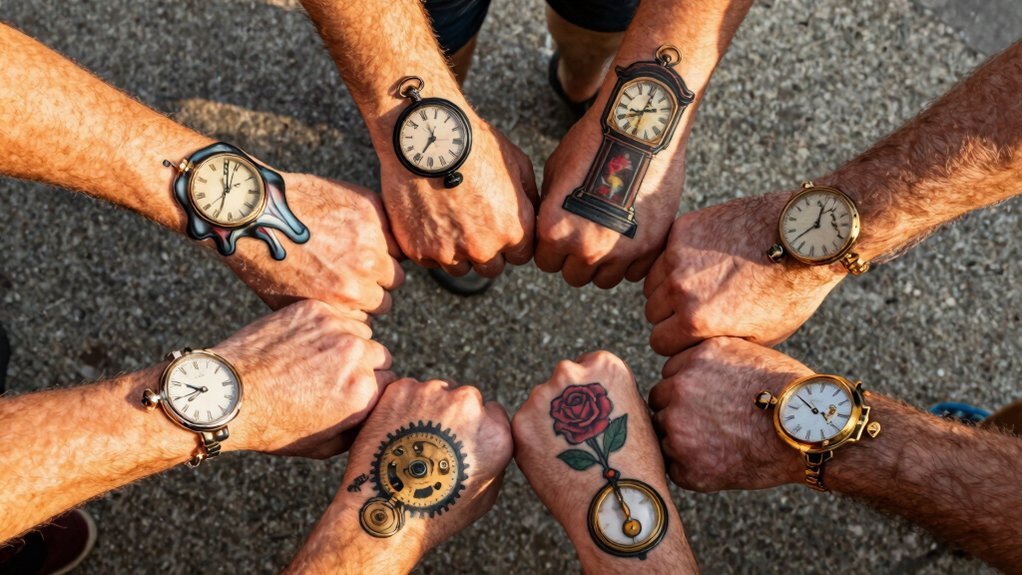
How do you make time stand still? You don’t—you capture its fragility instead. When you choose a broken clock, you’re marking loss, trauma, or a life that shattered at a specific moment. You carry the cracks visibly.
A melting clock dissolves boundaries. You reject rigid schedules and embrace fluidity, chaos, or dream logic. You’re channeling Dalí, yes, but you’re also admitting that time slips through your fingers when you try to grasp it.
A stopped clock freezes one instant forever. You commemorate birth, death, or transformation. The hands point to your pivotal hour, and you wear it like a photograph you can’t lose.
Each design asks what time has done to you—and what you’ve chosen to remember.
Recommended Products

A BEST GIFT: This novelty gift is great for art enthusiasts and laymen alike; Best gift for family and friends

Surreal Artistic Design<br> Handcrafted With Precision<br> Versatile Decor Piece<br> Easy Setup and Maintenance<br> Compact and Space-Saving<br>

DALI INSPIRED SURREAL DRIPPING DESIGN – Iconic Salvador Dali–style melting shelf clock creates a dramatic surreal accent piece for home or office décor, instantly elevating modern, vintage, or art-focused interior setups.
6 Clock Tattoo Styles and What They Say About You
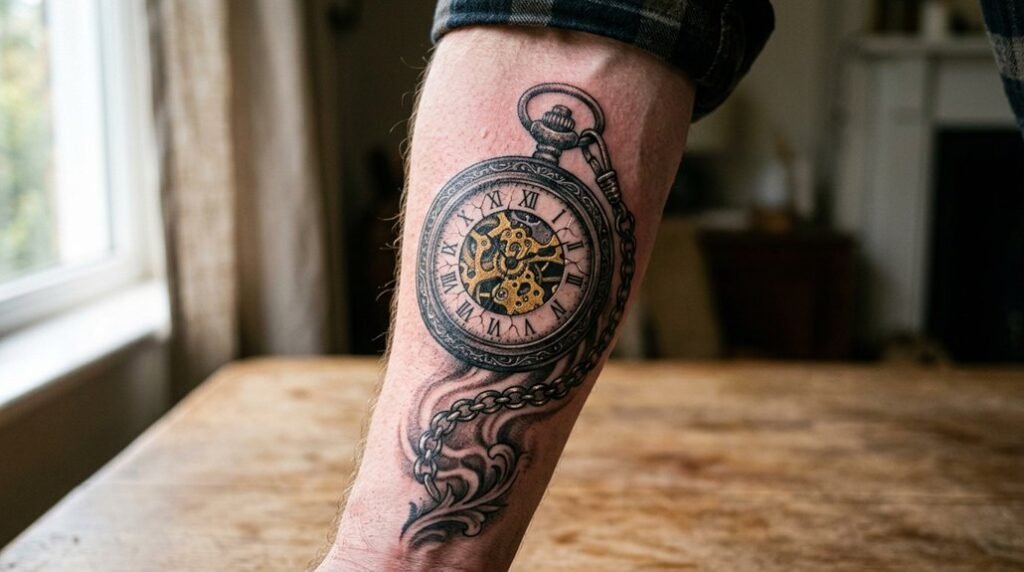
The meaning behind your clock tattoo shifts dramatically depending on the style you choose. A realistic pocket watch suggests you value tradition and craftsmanship. You appreciate life’s tangible moments.
Geometric clock designs reveal your analytical mind. You seek order in chaos and find beauty in mathematical precision.
Watercolor clocks expose your creative spirit. You embrace emotion over rigid structure.
Blackwork clocks demonstrate your boldness. You commit fully to your choices without hesitation.
Minimalist line art proves you’re selective about what deserves your attention. You strip away excess to find essence.
Biomechanical clocks merge flesh with machinery, showing you contemplate humanity’s relationship with technology.
Finally, trash polka styles scream rebellion. You reject convention and write your own rules about time’s meaning.
The Best Placement for Your Clock Tattoo
Where you place your clock tattoo changes everything about its impact. You should consider visibility, size, and personal meaning when choosing your spot.
Your forearm offers maximum visibility—you’ll see it constantly, reinforcing your connection to its message. Your chest or back provides canvas for intricate designs with melting elements or Roman numerals. You can hide these easily or reveal them deliberately.
Your wrist creates an intimate, ever-present reminder of fleeting moments. Your shoulder or thigh accommodates larger pieces without daily confrontation. You might prefer this distance if your tattoo marks painful memories.
Your neck or hand demands confidence—these placements broadcast your statement publicly. You can’t conceal them professionally.
Match your placement to your lifestyle. You work with your hands? Avoid finger tattoos that blur. You need discretion? Choose your ribcage. Your body tells your story; position it intentionally.
Recommended Products

Looking for a amazing Christmas gift for your Dad / Husband / Brothers / boyfriend / teacher ...? Look no further, this VIGOROSO pocket watch is a perfect gift for Christmas / Birthday / Anniversary / Valentine’s Day and any meaningful days. Accurately express your fully love. The bronze tone pocket watch is also a beautiful necklace decorating you, and a clothes chain matching your sweaters, dresses, and shirts.

NO BATTERIES, JUST WIND & GO Stay powered without charging or replacements. Hand wind mechanical movement keeps time running with simple daily winding, making it reliable for travel, daily carry, or special occasions.

Graphic Design pocket watch:design with animal dragon wolf crow cats Rose themed picture on the front, classic and unique design, very suitable for use as a fashion accessory.
How to Vet a Clock Tattoo Artist’s Portfolio
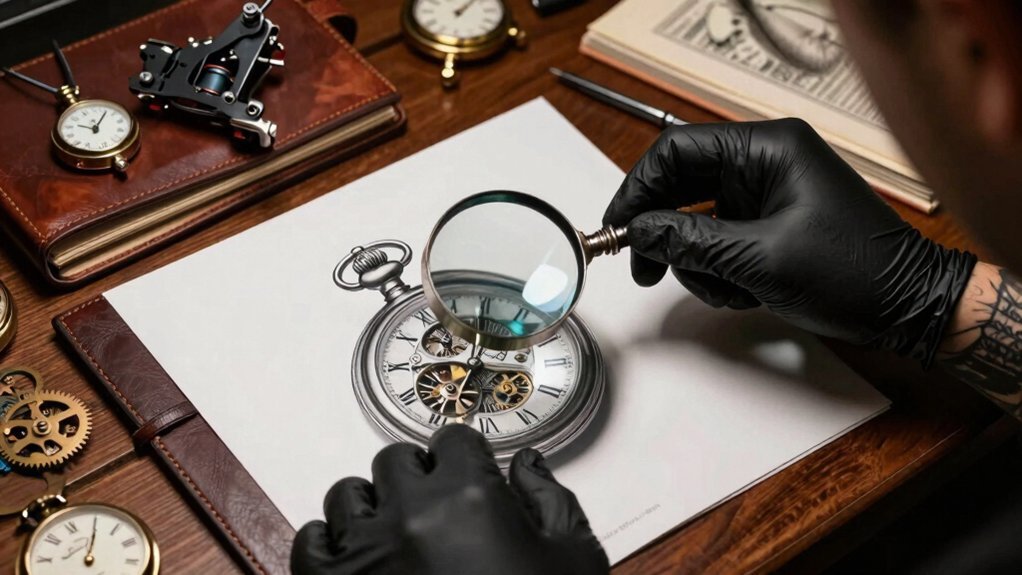
Why trust your skin to just anyone? You’ll need to scrutinize every portfolio carefully before committing. Start by examining healed tattoos—fresh ink hides flaws, but time reveals true skill. Check if clock faces maintain perfect symmetry; uneven numbers or warped gears signal sloppy linework. Zoom in on details—do Roman numerals align correctly? Are hands proportioned right? You’re looking for consistent depth and smooth shading transitions. Ask artists how they handle mechanical elements; clockwork demands precision. Request to see healed pieces in person when possible. Verify their experience with realism or neo-traditional styles, whichever matches your vision. Don’t let flash sheets fool you—custom work shows adaptability. Trust your instincts. If something feels off, keep searching. Your clock deserves someone who respects its complexity.
Recommended Products

【Color Change by Remote Control】- This tattoo shop decor clock has 7 colors of LED lights including red, purple, yellow, blue, green, white, and cyan. You can change the color at will. Tattoo light wall clock with 70.8-inch cord

✔[3D COOL MECHANICAL TEMPORARY TATTOO] Briyhose Cool Mechanical Tattoos Temporary Can Cover Your Body Parts Large. It Contains 8 Sheets 8.27 * 5.83 Inch (21 * 14.8cm) 3D Realistic Half Sleeve Mechanical Steampunk Fake Tattoo Stickers For Adults Men Women Tatto Kit. You Can Share It With Your Family And Friends.

【7 Colors To Change】-This red neon tattoo signs for shop wall clocks has 7 colors of LED lights including red, purple, yellow, blue, green, white, and cyan. You can change the color using the remote control. The 12 inch led tattoo clocks comes with a 70.8-inch cord
Conclusion
You’ve explored the layered meanings packed into every tick of a clock tattoo. Whether you’re drawn to mortality, transformation, or frozen moments, your design choice speaks volumes. Match style to story, placement to purpose, and never rush vetting your artist. Time’s waiting—now you know how to make it yours.
Recommended Products
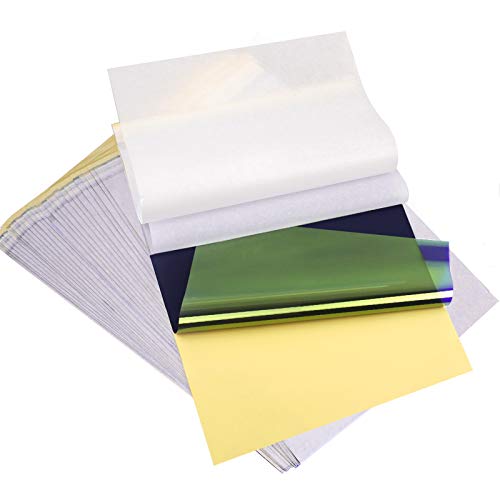
ADVANCED MATERIAL: Tattoo transfer paper is made with the high quality dyes and stencil paper. Transfer marks are very clear, clean and smooth. Tattoo transfer paper kit come with 35 sheets. Great for tattooing, trace and transfer images onto the body.<br>

Precised and longer lasting stencil artwork, Wont rub off while tattooing or using Green Soap. Vegan Friendly solution works well for all skin type

6 Styles Stencils: Each package contains 6pcs clock face PET templates, each measuring approximately 30x30cm/11.8x11.8inch, corresponding to 6 clock face designs: including retro Roman numeral designs, minimalist Arabic numeral designs, and clock faces with double decorative rings, plus 1 set of independent pointer templates (including various hour hand/minute hand designs). Different patterns are presented to showcase the scale and decorative details.