
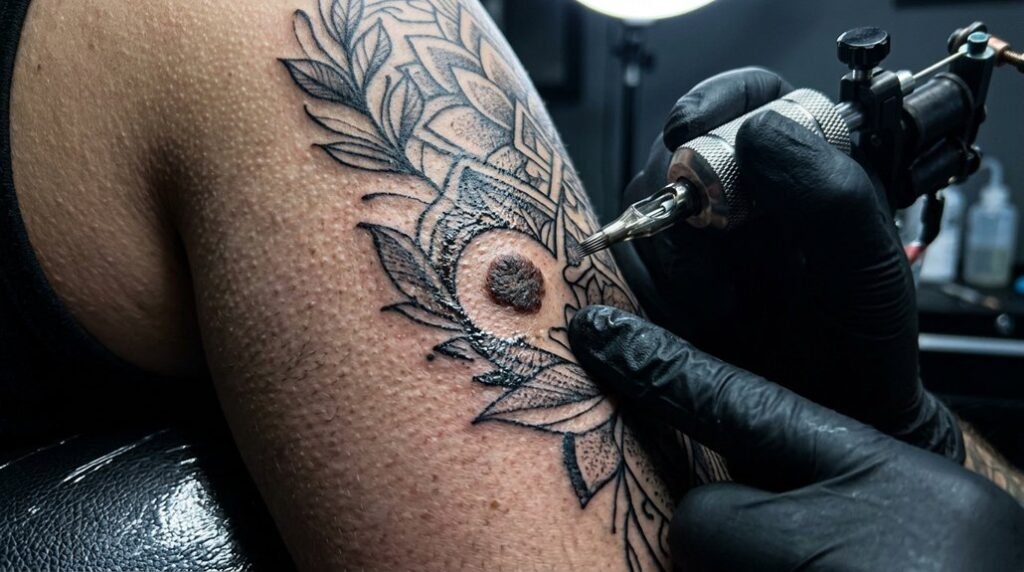
You’re considering a tattoo that overlaps with a mole, and you’ve likely heard mixed advice about whether it’s safe. The truth isn’t black and white—certain moles pose genuine risks when inked, while others can be worked around with the right precautions. What you do next depends on factors you might not have considered yet.
Key Takeaways
- Dermatologists discourage tattooing over moles because it obscures them from skin cancer monitoring.
- Avoid tattooing irregular, raised, bleeding, or changing moles, especially with family skin cancer history.
- Ink fades faster on moles due to melanocytes disrupting saturation, causing unpredictable, patchy results.
- Experienced artists can design around moles, incorporating them creatively or using negative space techniques.
- Post-tattoo, schedule annual dermatologist visits since the covered mole cannot be self-monitored visually.
Recommended Products

PACKAGE CONTENTS: Set of 10 black dot temporary tattoo stickers designed to create natural-looking beauty marks and moles

Improve Tattoo Skills: These soft tattoo practice skins can be curved to mimic real skin, helping you learn to tattoo contoured body parts. They are ideal for beginners practicing tattoos, eyebrows, eyeliner, and lips
10PCS Professional Thick Skin: Features 2mm thick silicone for advanced tattoo practice and microblading training. Durable enough for deep needle work and color packing – the best tattoo training kit for pros
Can You Tattoo Over a Mole? The Safety Answer Upfront
A mole on your skin doesn’t automatically disqualify you from getting a tattoo, but covering it requires careful consideration. You can technically tattoo over a mole, and many artists do this routinely. However, you’re making a choice that carries real implications for your health monitoring.
When you ink over a mole, you’re obscuring it from view. You won’t notice if it changes shape, color, or size—signs that could indicate melanoma or other skin cancers. Dermatologists strongly recommend against this practice because early detection saves lives. You’re essentially choosing aesthetics over vigilance.
If you proceed, you should first get the mole evaluated by a dermatologist. They’ll assess whether it’s benign and stable. You’re also committing to regular check-ups since you’ll lose the ability to self-monitor that specific spot. The decision demands you weigh beauty against long-term health awareness.
Recommended Products

Protect Your Body Art: Moisturizing with the bonus of itch relief! Tattoo Goo's Tattoo Care Lotion soothes healing skin & keeps healed ink looking sharp for life. With olive oil & glycerin, it delivers deep, breathable hydration that won’t clog pores

Nourishes Healing Ink for Vibrant Color: Tattoo Goo supports healing tattoos & maintains vibrancy on healed ink with a lightweight formula rich in olive oil, lavender oil, cocoa butter, and beeswax. It absorbs quickly, moisturizes deeply, and helps reduce dryness, itch and tightness so your tattoo looks and feels comfortable through everyday routines
Protect your Body Art: Getting inked takes a toll on your skin. What you lose in moisture, we give right back. Our formula mimics your skin’s natural hydration so it absorbs fast, works harder, and helps your skin recover faster
Moles You Should Never Tattoo Over
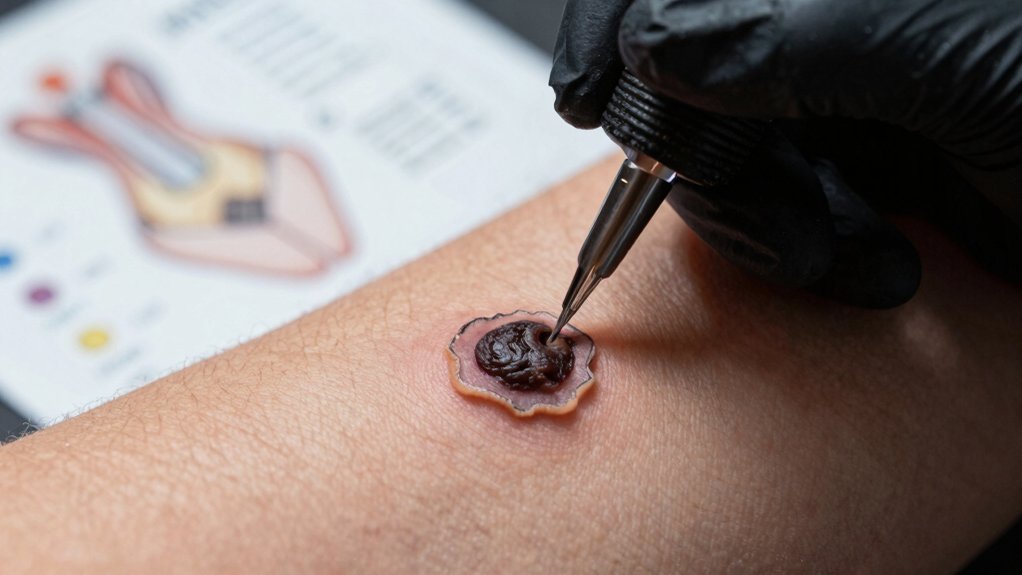
Which moles pose too much risk to cover with ink? You should never tattoo over irregular moles, moles that change in size or color, or any mole your dermatologist monitors closely. These warning signs suggest potential melanoma, and covering them delays detection.
You must also avoid tattooing over raised moles, bleeding moles, or those with asymmetrical borders. Needle penetration risks breaking skin and obscuring cellular changes that signal disease progression.
If you have a family history of skin cancer, you shouldn’t cover any atypical moles regardless of current appearance. You’re gambling with early diagnosis when you hide suspicious tissue beneath pigment.
Check every mole with a dermatologist before scheduling your tattoo appointment. Your artist can’t assess medical risk; only you and your doctor can make that determination.
How Ink Fades and Shifts on Tattooed Moles
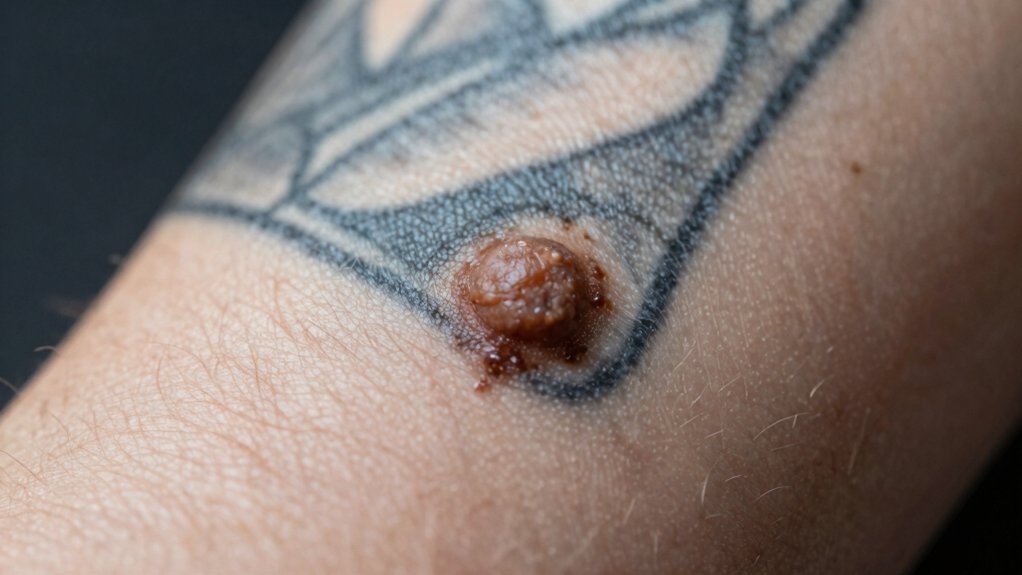
Why does your mole tattoo look different after a few months? Your mole’s biology actively fights against the ink. Moles contain dense clusters of melanocytes—cells that produce pigment—and these cells don’t hold tattoo ink the same way regular skin does. You’re watching the ink spread unpredictably because mole tissue has a different cellular structure and blood supply than surrounding skin.
The ink fades faster on your mole because those melanocytes shed and regenerate more rapidly. You’re also seeing color shifts as the mole’s natural pigment mixes with the tattoo pigment. Darker moles alter how colors appear, and you can’t predict how they’ll look once healed.
Your tattoo artist deposits ink at varying depths across different skin types. On moles, you’re getting uneven saturation, which creates patchy results. The ink simply doesn’t settle where you want it.
Recommended Products

Quantity: 10 Pieces individual tattoo sheets, with 30+ unqiue cosmo galaxy universe designs, including boho style sun, moon, planets chain, moon and star charms tassels, shooting stars, etc.

★【28 Sheets! Variety Outer Space Temporary Tattoos For Women Men Kids】--Contain More Than 500 Exquisite Designs COKTAK Brand Variety Waterproof Temporary Tattoos For Kids Boys Girls Teens Fashion Hot Popular Designs Tattoo Stickers in One Package.【Size】: 28 Sheets Cute Universe Small Temporary Tattoos Stickers For Kids aughters Son Children 10.5x6CM 4.1x2.3inch.

🌟33 Sheets Variety Designs -- JOEHAPY Brand Temporary Tattoos For Kids Women Men Adults. One Package Includes 8 Sheets HOT Custom Large Geometric Planets Temporary Tattoos For Women and 25 Sheets Small Black Temporary Tattoos For Men Star Wolf Lion Gothic Moon Sun Cute Outer Space Universe Abstract illustration Cosmos Astronaut Galaxy Triangle Pine Tree City Satellite Solar System Line Art Feather Mountain Geometry Bracelet Forearm Temporary Tatoos Paper.
How Artists Tattoo Around Moles Without Risk
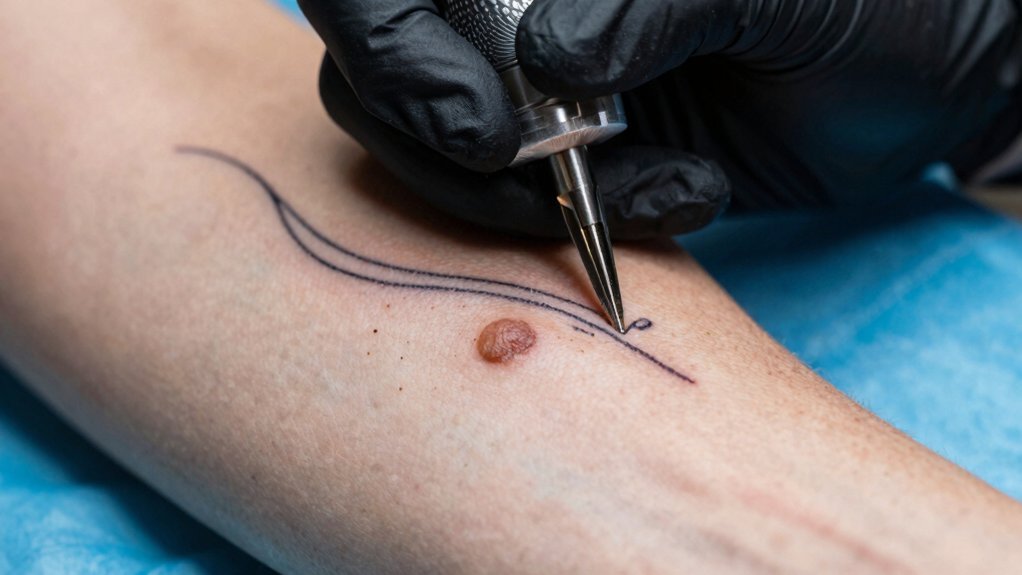
How can you get the tattoo you want without jeopardizing your skin’s health? You’ll need an artist who knows how to work around your moles safely.
First, you’ll seek out a professional with experience tattooing near raised or pigmented skin. They’ll examine your mole’s texture, size, and location before starting. They’ll map your design to flow naturally around the spot, leaving healthy skin untouched.
Your artist won’t stretch or press directly on the mole. They’ll maintain steady hand support from adjacent areas, preventing needle contact with the raised tissue. They’ll adjust needle depth and speed near edges, avoiding accidental penetration.
You’ll watch them sanitize the surrounding skin thoroughly. They’ll avoid wiping the mole with abrasive materials. Post-session, they’ll instruct you to monitor for irritation.
This approach protects you while delivering your desired artwork intact.
Design Options When Your Mole Can’t Be Covered
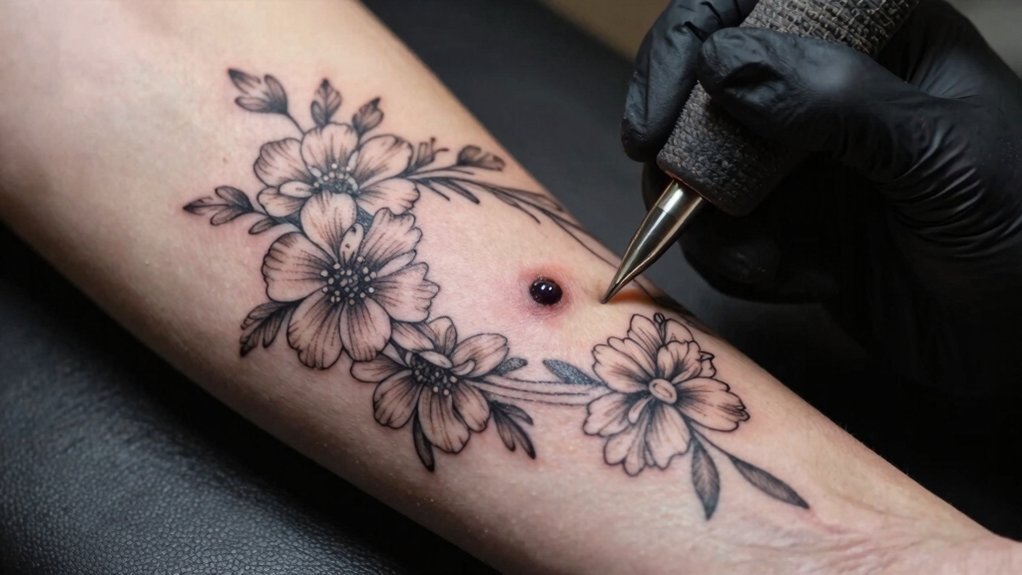
Where exactly can you place your design when a mole sits squarely in your intended tattoo area? You work with it, not against it. Your artist can frame the mole as a focal point—incorporating it into an eye, a flower center, or a celestial body.
You might choose negative space designs that leave the mole intentionally untouched, letting your natural skin become part of the artwork. Alternatively, you shift the entire composition to wrap around the spot, creating organic flow that accommodates the interruption.
Some designs benefit from interruption; a snake winding past creates visual interest. You discuss these options during consultation, bringing reference images that show similar creative solutions. Your artist sketches approaches that honor both your vision and the mole’s presence. You select the option that feels intentional, not compromised.
Recommended Products
Package include: 2 sheet of Supperb temporary tattoo (ST-59). Sheet Size: 8 x 4 inches wide and tall (20cm x 10cm). Quality temporary tattoo. Safe & non-toxic, printed with...
Monitoring Your Tattooed Mole for Health Changes
Once you’ve settled on a design that accommodates your mole, your responsibility shifts from aesthetics to vigilance. You’ll need to monitor that tattooed spot more carefully than your other moles because ink obscures visual inspection.
Take monthly photos with consistent lighting to track changes. You’ll examine the surrounding skin for redness, swelling, or texture changes since the mole itself hides beneath pigment. Don’t rely solely on visual checks—run your fingers across the area to detect any raised edges or lumps that weren’t there before.
Schedule annual dermatologist visits and specifically point out tattooed moles. Request dermoscopy examinations, as these penetrate ink layers. If you notice rapid growth, bleeding, or persistent itching, you’ll book immediate appointments. Your tattoo hasn’t eliminated skin cancer risk; you’ve simply made detection harder. Stay proactive.
Conclusion
You can tattoo over a mole, but you’ll need your dermatologist’s approval first. Have them confirm it’s benign and stable, then work with an artist who can design around or incorporate it safely. Don’t skip monthly self-checks and annual professional monitoring—ink makes spotting changes harder, not impossible. Your skin’s health comes before any design, so stay vigilant and act quickly if you notice anything unusual.
Recommended Products

【 UNIQUELY DESIGNED SPACE TATTOOS 】:You will get 102 Styles uniquely designed planet astronaut rockets temporary tattoos for kids, measuring 1.6 inches long and 1.6 inches wide.Put your child in a great mood with these space tattoos for kids! erfect for playdates, birthday parties, and family gatherings.

【77SHEETS UNIQUE DESIGNS】It comes in bigger and smaller sizes, Half Arm 7.48 * 3.74 in (19 * 9.5 cm) * 17 pieces/ Tiny Size 3.85*2.28 in (9.8*5.8cm) * 60 pieces

⚡Set Includes 74 Styles Planets Temporary Tattoos for Kids Party Supplies-- Super cool and fun kids temporary tattoos. This tattoo sticker set contains many fun elements that kids will like (earth, mars, saturn, moon, venus, comet, mercury). Add an individual extra touch of fun to a children’s party or event with Charlent tattoos.