
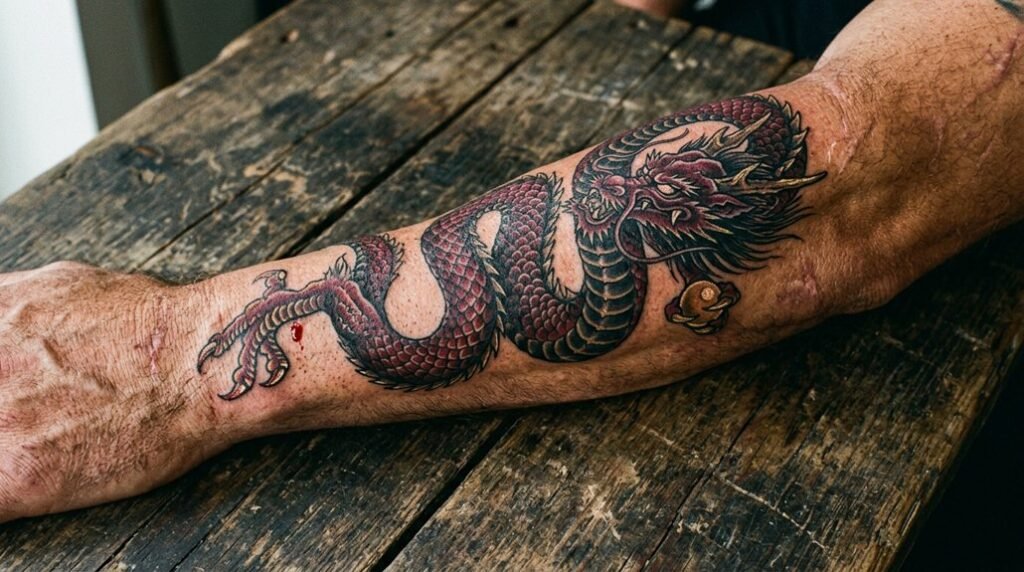
You’re considering a dragon tattoo, and you likely know it carries weight—but you might not realize how sharply that meaning shifts depending on where you look. A Japanese *ryū* whispers of balance and fortune, while a coiled Celtic beast snarls with defiance. What story will yours tell, and why does placement matter just as much as the scales themselves?
Key Takeaways
- Eastern dragons symbolize wisdom, protection, and harmony with cosmic forces through their serpentine, pearl-clutching forms.
- Western dragons represent rebellion, resilience, and inner strength forged through conflict and hardship.
- Placement carries distinct significance: back for protection, chest for heart-held power, arms for visible dominance.
- Dragons commonly mark personal transformation, survival through darkness, and battles successfully endured.
- Heritage and personal mythology guide the choice between Eastern balance-seeking or Western individual-power symbolism.
Recommended Products

⯁ 400+ Reusable Henna Stencils: Get 24 sheets of high-quality, self-adhesive hollow templates featuring over 400 unique patterns. These temporary tattoo stencils allow you to create stunning body art including mandalas, butterflies, and dragons. Perfect for practicing techniques without permanence


Japanese Style Tattoo Designs::-- These 6 full arm temporary tattoos feature traditional Japanese designs, including dragons, koi fish, phoenix, and samurai, bringing an authentic touch to your look.
Eastern Dragon Tattoo Meaning: Power, Wisdom, and Protection
Where exactly do Eastern dragons come from, and why do they carry such weight in tattoo culture? You trace their roots through China, Japan, and Korea, where they’ve commanded reverence for millennia. Unlike their destructive Western cousins, Eastern dragons bring rain, govern rivers, and symbolize imperial authority.
You choose this creature when you seek power without aggression. The dragon coils through your skin as a guardian, warding off harm and attracting fortune. Its serpentine body flows with water, not fire, representing adaptability and wisdom gained through age.
You’re not marking rebellion; you’re claiming connection to something ancient and benevolent. Each scale you wear acknowledges your respect for knowledge, your desire for protection, and your hope for prosperity. The tattoo becomes your personal talisman, bridging mortal and divine.
Recommended Products

Celtic Knot Animals Painting Stencil: Include 9pcs celtic knot animals stencils, 20x20cm/7.9x7.9inch, medium size, convenient for handheld operation, and able to meet the drawing needs of larger areas. Whether it's decorating cards, making handmade accounts, or creating wall art, it can be easily adapted.

These colorful stickers are perfect for fun at home; school; or on the go

✨ 10 Extra-Large Designs: This set features 5 large A4 sheets with 10 massive tribal patterns, including the Tiger, Dragon, Wolf, Eagle, and Scorpion. Each design is perfectly sized for high-visibility areas like the upper arm, back, chest, or thigh, providing a bold and professional tattoo look.
Western Dragon Tattoo Meaning: Rebellion, Strength, and Inner Battle
Western dragons emerge from different soil entirely—European folklore and medieval serpents that hoard gold, terrorize villages, and test the bravest heroes. You don’t choose this creature for luck or harmony. You claim it for struggle.
Your Western dragon tattoo declares rebellion. You’re defying authority, breaking chains, refusing silence. The beast doesn’t serve you; you battle it. Every scale traces your inner war—fear against courage, doubt against will.
You wear this symbol when you’ve fought alone. When you’ve faced your own darkness and survived. It marks resilience forged through conflict, not granted by grace.
You understand a crucial truth: strength wins, but only after struggle. Your dragon bleeds. It burns. Yet it rises. So do you.
Recommended Products

SIZE - 10 sheets realistic temporary tattoos with beautiful designs, original brand of Briyhose fake tattoos for adults women kids girl, size is 8.2*4.5 inch (21*11.5cm) 10 Sheets tatoos kit, used for arms, half sleeves, forearm, shoulder, back, spine, neck, hands, legs, thigh and any other part of your body skin.

🐳[8 Sheets Black Dragon Tattoos in One Package!] - Original Brand of TASROI 3D imperial loong Tribal Dragon Temporary Tattoos For Women Men and Adults. Tattoos Temporary Contains 8 Large Sheets Water Transfer Animals Dragon Floral Flower Rose Moon Serpent Totem Armband Etc.

【VALUE COMBO – 23 UNIQUE SHEETS FOR MIX & MATCH】 This set includes 23 individual sheets – 10 large half-sleeve tattoos (8.27"×4.72") and 13 small accent tattoos (3.87"×2.36"). Every sheet has a unique design – no repeats. Mix large and small pieces freely to create a custom look, from bold full-arm statements to subtle wrist or neck accents.
Asian or European Dragon Tattoo: How to Choose Your Style
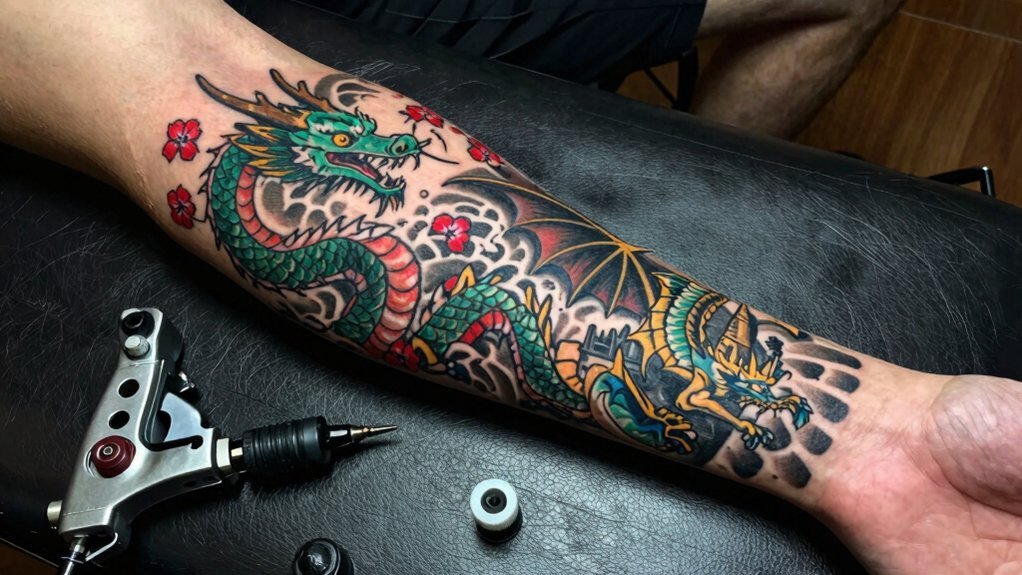
How do you choose between two beasts that barely share the same sky? You’re deciding between wisdom and conquest, between flowing serpents and armored titans.
Ask yourself what you value most. Do you seek harmony, longevity, and spiritual ascent? You’ll gravitate toward Asian dragons—lung, ryū, or yong—with their sinuous bodies, whiskered faces, and pearl-clutching claws. These creatures bring rain, guard treasures, and embody cosmic balance.
Or do you claim individual power, fierce protection, and untamed will? European dragons suit you better—winged, fire-breathing, hoard-guarding beasts that knights fear and you respect. They’re loners, survivors, symbols of your inner fight.
Your heritage, aesthetic taste, and personal mythology guide you. Neither choice is wrong. Both mark you as someone who recognizes power in ancient forms.
Recommended Products

REALISTIC DRAGON & SWORD PATTERN ART: Ultra-fine printing with plant-derived gardenia ink creates bold, lifelike dragon & sword pattern tattoos with detailed designs that mimic real ink. Our semi-permanent formula sits subtly under the skin for authentic

Extensive Coverage & Generous Supply:Each package includes 8 sheets (17cm * 48cm) of temporary tattoos, perfect for full-arm designs. Plenty to share with friends and family for group events or parties

Extensive Coverage & Generous Supply:Each package includes 8 sheets (17cm * 48cm) of temporary sleeve tattoos, perfect for full-arm designs. Plenty to share with friends and family for group events or parties
Dragon Tattoo Placement Meanings: How Location Alters Symbolism
A dragon sprawling across your shoulder speaks differently than one coiled around your wrist. You choose your placement carefully because location transforms meaning.
When you ink a dragon across your back, you’re claiming protection and strength. Your chest placement keeps power close to your heart. You wrap one around your arm when you want visible dominance—every handshake displays your symbol.
You hide a small dragon on your ankle for personal significance, not public display. Your neck placement demands attention; you can’t conceal it easily. You select your thigh or hip when intimacy matters more than visibility.
Size shifts interpretation too. You compress a dragon onto your finger and it becomes delicate, almost playful. You expand it across your torso and it becomes undeniable. Your body becomes the landscape where your dragon lives, breathes, and communicates your intent.
Recommended Products

Comfortable material: these sun protection arm sleeves are made of fabric, featuring breathable and lightweight, no pilling or fade, and these fingerless gloves with high elasticity will bring you a nice experience

SOFT AND STRECHABLE: The tattoo arm sleeves made of 92% nylon and 8% spandex soft fabric material, stretchable to fit your arm. Help to protect your arm from the strong direct sunlight.

[Traditional Japanese Art with Lifelike 3D Printing] Stand out with a detailed traditional Irezumi pattern. Unlike cheap flat prints, our seamless 3D printing creates an incredibly realistic tattoo look without the pain or permanent commitment.
What Dragon Tattoos Mean to the People Who Have Them
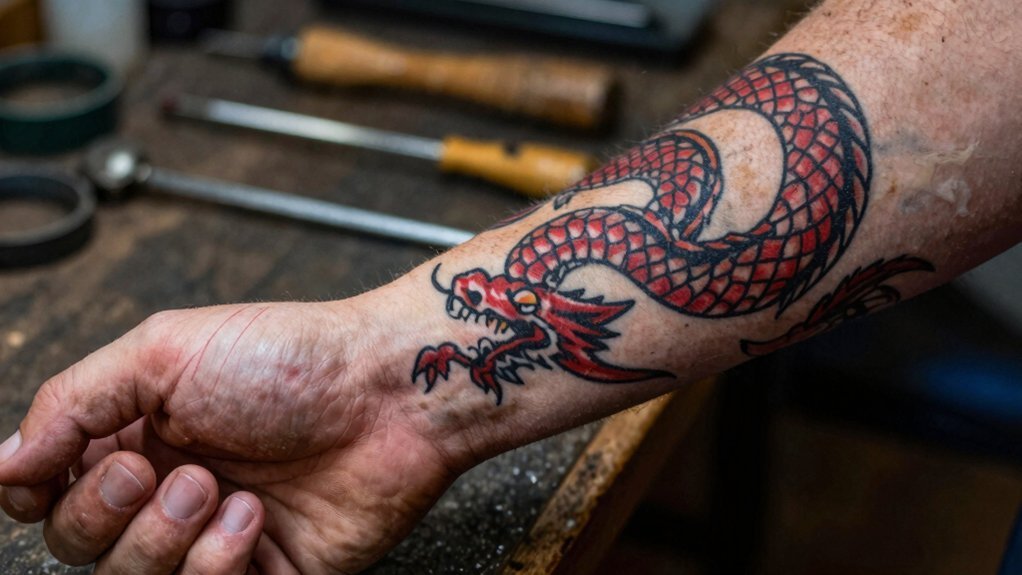
You’ve mapped where your dragon lives on your skin, but the deeper story lives in why you chose it at all.
You didn’t pick this creature for decoration. You chose it because you’ve fought battles nobody witnessed. Your dragon marks survival, transformation, or the fire you’ve kept burning through darkness. Maybe it guards grief you’ve transformed into strength. Perhaps it celebrates heritage, carrying ancestral power across generations. You wear it as armor against doubt, as proof you’ve earned your scales through struggle.
Each person’s dragon breathes different meaning. Yours might whisper endurance; another’s roars rebellion. You’ll spot someone else’s ink and recognize the unspoken language—two warriors acknowledging each other’s storms without speaking.
Your dragon doesn’t explain itself to strangers. It doesn’t need to. You’ve already written the meaning in muscle and memory.
Recommended Products

✔[FULL SLEEVE FLOWER TATTOO] Briyhose Colorful Japanese Drama Full Arm Temporary Sleeve Tattoos Can Cover Your Body Parts Large. It Contains 4 Sheets 18.9 * 6.7 Inch (48 * 17cm) Long Sleeves Monster Fish Japan Stage Play Fake Tattoo Stickers For Women Tatto Kit. You Can Share It With Your Family And Friends.


Durable & reusable airbrush stencil for creating realistic tattoos
Conclusion
You’ve journeyed through dragon tattoo meanings across cultures and placements. Whether you’re drawn to Eastern wisdom or Western defiance, your choice becomes personal armor. Where you ink it—back, chest, arm, or ankle—shifts its message to the world. Ultimately, you’re claiming transformation, resilience, and fire that’s uniquely yours. So go ahead: let your dragon breathe.
Recommended Products

Intricate Celtic Dragon Design – High-quality stencil featuring a Celtic dragon with knotwork details, perfect for precise, professional results.

Easy to Use : These stencils ensure a flawless finish, making them suitable for both beginners and professionals. Experiment with different paint patterns and unleash your creativity!

PACKAGE INCLUDES 20 sheets of 6X6 inch Celtic knot stencils. 16 individually designed patterns; 2 sizes for each Celtic pattern: about 5.5 inch and 2.5 inch.